
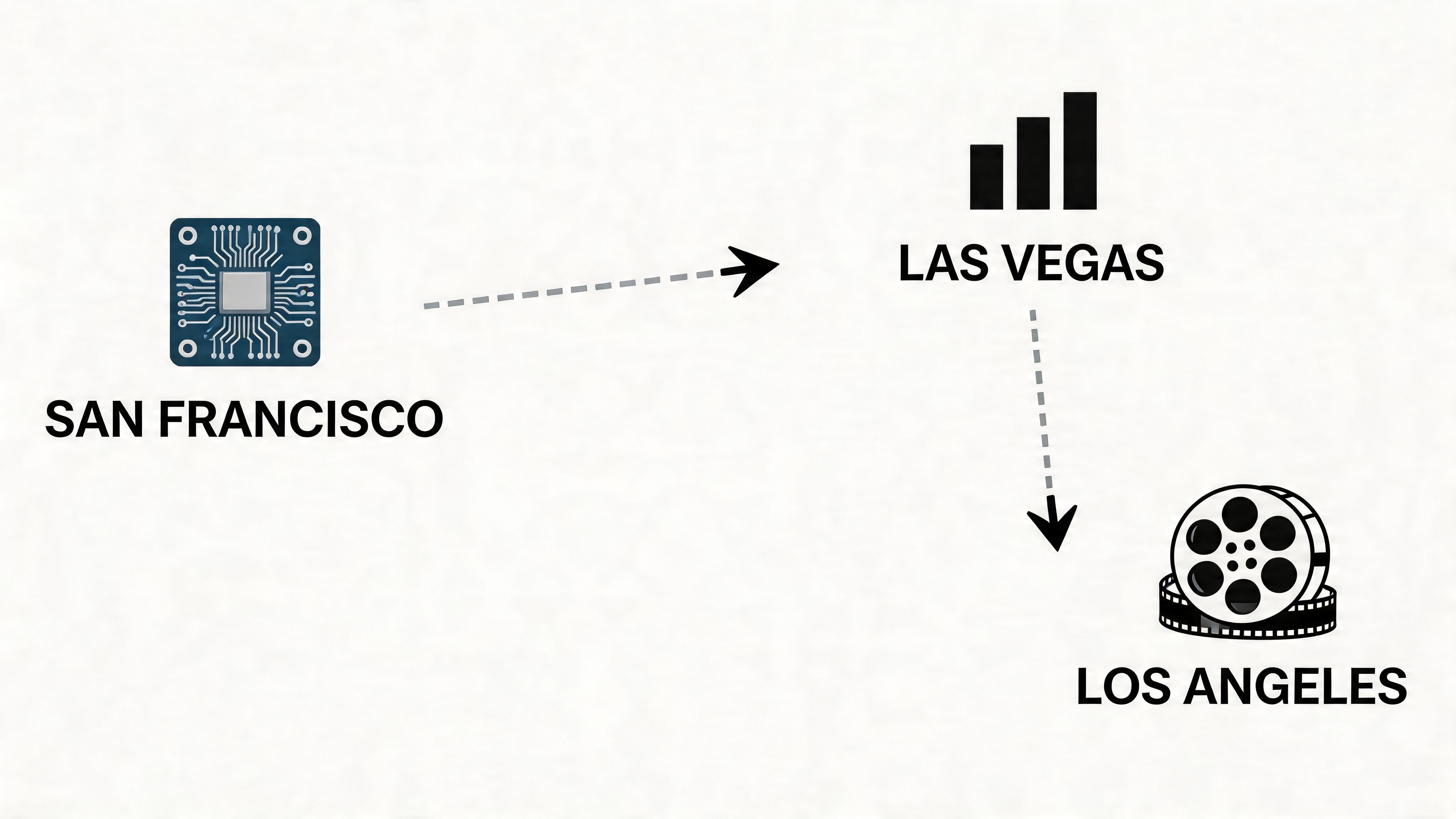
You get the calendar invite at 6:40 p.m. San Francisco on Tuesday, Las Vegas on Wednesday, Los Angeles on Thursday, back home late Thursday night if possible. The usual consumer travel advice is useless in that moment. You don't need a scenic route, a beach stop, or a list of overlooks. You need a trip that protects meeting time, reduces handoffs, and doesn't leave you juggling flights, hotel confirmations, receipts, and last-minute changes across six apps.
That’s the core san francisco las vegas los angeles problem for busy professionals. It isn’t geography. It’s coordination. A three-city run can be productive, but only if you treat it like an operating system, not a vacation. The goal is simple: no car, minimal friction, and every transfer planned around work output instead of travel romance.
Table of Contents
The Modern Executive's West Coast Challenge
What breaks on this route
Strategic Route Planning Driving Versus Flying
What driving actually costs a professional
Why flying wins on this route
The business standard
Building Your Dynamic Three-City Itinerary
Framework one, tech then conference then meetings
Framework two, conference first then follow-up cities
Framework three, investor circuit with minimal overnight drag
Sequencing rules that hold up
Executing Seamless Bookings and Logistics
Start with constraints, not search results
A clean booking workflow
What works and what doesn't
The handoff standard
Mastering Productivity Between Meetings
Turn transit gaps into fixed-purpose blocks
Use one command standard for every moving part
Keep expenses moving while the trip is moving
Protect cognitive quality, not just clock time
The no-car advantage that matters most
Putting Your Trip on Autopilot with Superchat
Sample commands that actually work
One thread beats a stack of apps
The prompt style to use
Where this approach pays off
Conclusion The Zero-Friction Business Trip
The Modern Executive's West Coast Challenge
A multi-city West Coast trip usually fails before takeoff. The problem starts when someone treats San Francisco, Las Vegas, and Los Angeles like a leisure loop instead of three very different business environments stitched together by tight timing. One missed handoff turns into a late arrival, a compressed meeting, and a messy expense trail by the end of the day.
That pressure has only increased as travel returned. A 2025 Statista report cited in this brief notes that US domestic business travel rebounded 15%, while 62% of executives report significant productivity loss from scheduling fragmentation across multiple apps in trips like this one, where time optimization matters most (road-trip article citing the Statista business travel figure).
The mistake I see most often is thinking the hard part is booking transportation. It isn't. The hard part is keeping the entire trip coherent when a gate changes, a meeting runs over, or the hotel you picked is technically in the right city but wrong for the next morning’s first appointment.
What breaks on this route
Fragmented scheduling: Your flight app, hotel app, calendar, rides, and expenses all live in separate places.
Overcommitted days: Teams stack meetings as if airport transfers and check-ins don't exist.
False flexibility: A rental car feels like control until parking, traffic, and retrieval time start eating the day.
For executives and assistants, the practical frame is corporate travel management, not travel inspiration. If you want a good refresher on how managed travel programs reduce friction around policy, bookings, and traveler support, this overview of corporate travel management is useful context.
Practical rule: On the SF-Vegas-LA circuit, the itinerary that looks cheapest on paper often costs the most attention.
The right mindset is operational. Protect mornings for movement when needed. Keep midday for revenue or decision-making meetings. Push admin into controlled blocks. The professionals who handle this route well don't travel more heroically. They remove decisions before the trip starts.
Strategic Route Planning Driving Versus Flying
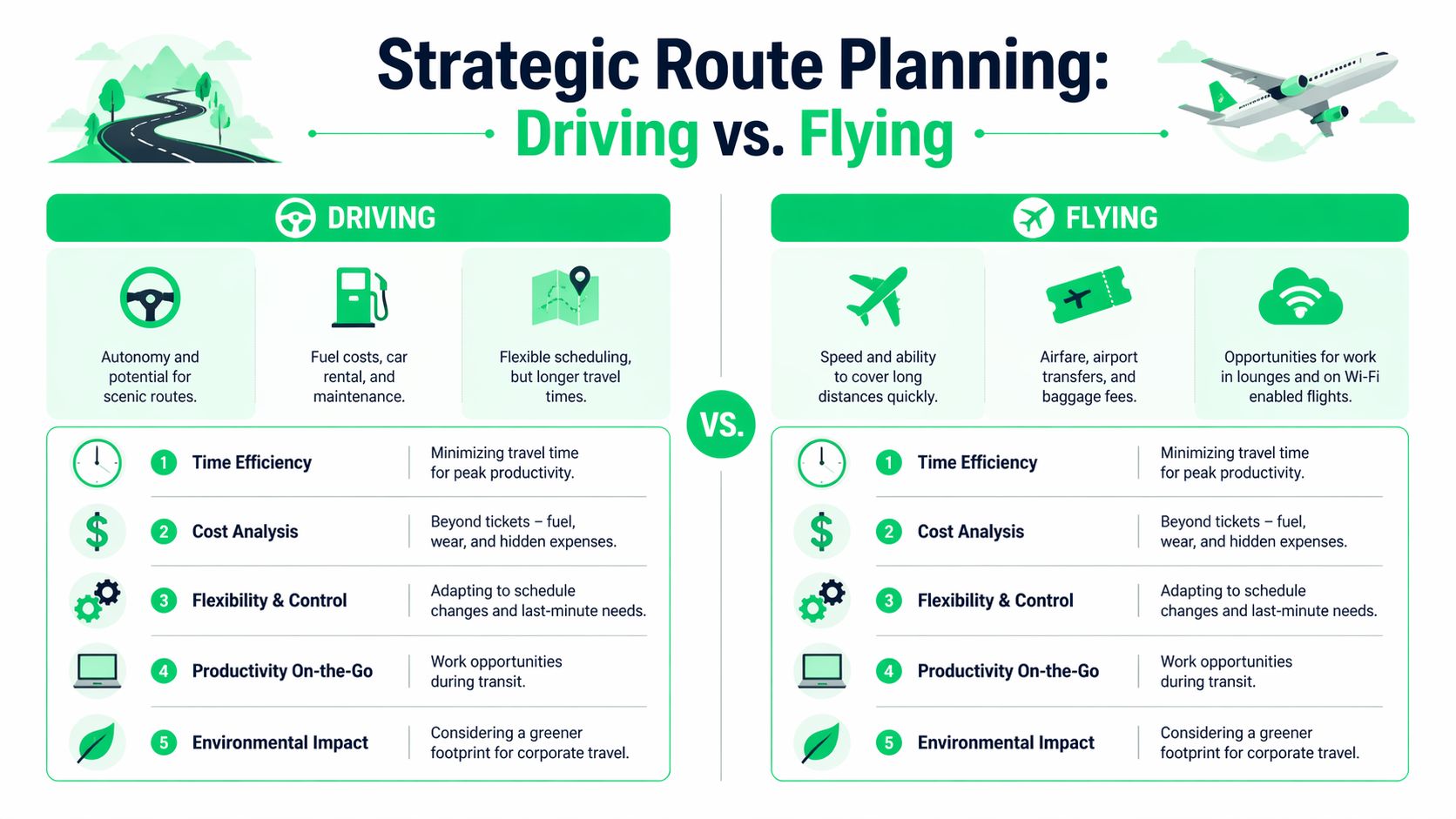
For business travel, driving on this triangle usually loses. It gives you independence, but it also turns transit into dead time. You can't review sensitive materials comfortably, take many calls reliably, or arrive sharp after a long haul plus city traffic.
Flying keeps the trip modular. Each leg stands on its own, which matters when one city expands or drops off at the last minute. That modularity is what preserves the rest of the schedule.
What driving actually costs a professional
A car works for leisure because leisure tolerates drift. Business travel doesn't.
Decision factor | Driving | Flying |
|---|---|---|
Work capacity | Limited and inconsistent | Better if you use lounges, boarding windows, and in-flight Wi-Fi |
Fatigue profile | High mental drain after long road time | More stop-start, but easier to preserve focus |
Schedule recovery | Hard to recover from traffic or a delayed departure | Easier to rebook one leg and preserve the rest |
Urban friction | Parking, pickup, drop-off, hotel access | Airport transfer friction, but no parking burden |
Trip design | Better for open-ended routes | Better for fixed meeting sequences |
The rail question comes up often, especially for Las Vegas and Los Angeles. The long-term idea is promising, but it doesn't solve today's executive schedule. The Las Vegas to Los Angeles Rail Corridor Improvement Feasibility Study projects that a future 110 mph passenger rail line could offer 2-hour travel times, but the same study notes current freight priority conflicts and regulatory hurdles, which is why it isn't yet a viable choice for time-sensitive business travel.
Why flying wins on this route
Use flights because they give you cleaner decision points. A good executive itinerary isn't built on romance. It's built on recoverability.
San Francisco to Las Vegas: This is the classic early departure leg. Take the first workable flight that still leaves room for an adult morning routine.
Las Vegas to Los Angeles: Keep this leg short and tactical. It’s often best treated as a same-day transfer tied to one anchor meeting.
Los Angeles to San Francisco: End with the latest acceptable return if the LA schedule is revenue-critical.
If you're comparing options directly, a flight search tool that prioritizes filters instead of forcing endless tab-hopping matters. A dedicated flight booking workflow should let you define parameters like departure window, seat preference, and same-day return logic up front.
The business standard
Driving still has a place if you're carrying equipment, covering secondary stops, or making the trip part of a client visit arc. For most founders, operators, sales leaders, and executive assistants, though, the san francisco las vegas los angeles circuit works better when you fly each leg and remove the rental car entirely.
If you need precision, don't choose the transport mode that asks you to absorb every mile personally.
Building Your Dynamic Three-City Itinerary
The best order depends on the job the trip needs to do. These cities aren't interchangeable. San Francisco compresses decisions and rewards speed. Las Vegas concentrates people in one place, which makes it ideal for conventions, partner meetings, and stacked introductions. Los Angeles tends to run on timing plus relationships, which means buffers matter more than many visitors expect.
That pattern has deep roots. The history of Las Vegas notes that the 1905 railroad linking Los Angeles, San Francisco, and Las Vegas helped shape their distinct economic identities. Today, Los Angeles has a population of nearly 4 million, Las Vegas drew 42 million visitors before 2020, and San Francisco remains globally tied to tech, which is exactly why sequencing matters for business planning.
Framework one, tech then conference then meetings
Start in San Francisco when the trip depends on investor, product, or partnership conversations that require your best attention. Move to Las Vegas next if the middle of the trip is built around a conference, expo, or industry gathering. Finish in Los Angeles for studio, brand, media, or enterprise follow-ups.
This order works because the highest-cognitive meetings happen first, while your energy is clean. Vegas then becomes a volume city. LA closes the trip with meetings that often benefit from context gathered earlier in the week.
Framework two, conference first then follow-up cities
If the event in Las Vegas is the reason for travel, begin there. Use the conference to collect leads, pressure-test messaging, and identify who merits an in-person follow-up. Then fly to Los Angeles or San Francisco based on where the higher-value next meetings sit.
A practical version looks like this:
Las Vegas first: Attend the event, host dinners, and confirm who needs face time.
Los Angeles second: Good when the next step is relationship development, media, or commercial partnership discussion.
San Francisco third: Better when the final stop requires decision-makers, product depth, or fundraising context.
Framework three, investor circuit with minimal overnight drag
For a dense, senior-level schedule, reduce hotel changes mentally by assigning one mission to each city.
San Francisco for decisions. Book the city where strategic alignment happens.
Los Angeles for visibility. Use LA for meetings where presence, trust, or creative review matters.
Las Vegas for concentration. Save Vegas for events or blocks of meetings in one property cluster.
Operating principle: Don’t order the cities by map logic. Order them by where your sharpest hours create the most value.
Sequencing rules that hold up
Put your hardest meeting first. Don’t save your most important conversation for the city where delays are hardest to absorb.
Use Vegas as a compression point. When many stakeholders are already there, take advantage of that concentration.
Let LA breathe. Even when flights are short, local timing in Los Angeles can make a tightly packed day feel brittle.
A good itinerary feels slightly underbooked before departure. That’s usually the sign it has enough room to survive reality.
Executing Seamless Bookings and Logistics
Most booking mistakes happen because people book components separately. They choose a flight, then later a hotel, then later think about transfers, then finally remember the calendar. That sequence creates bad combinations. A flight that looks fine in isolation may force an awkward hotel check-in window or put you too far from the next morning’s meeting cluster.
The better method is to treat flights, hotel, and ground transport as one booking decision.
Start with constraints, not search results
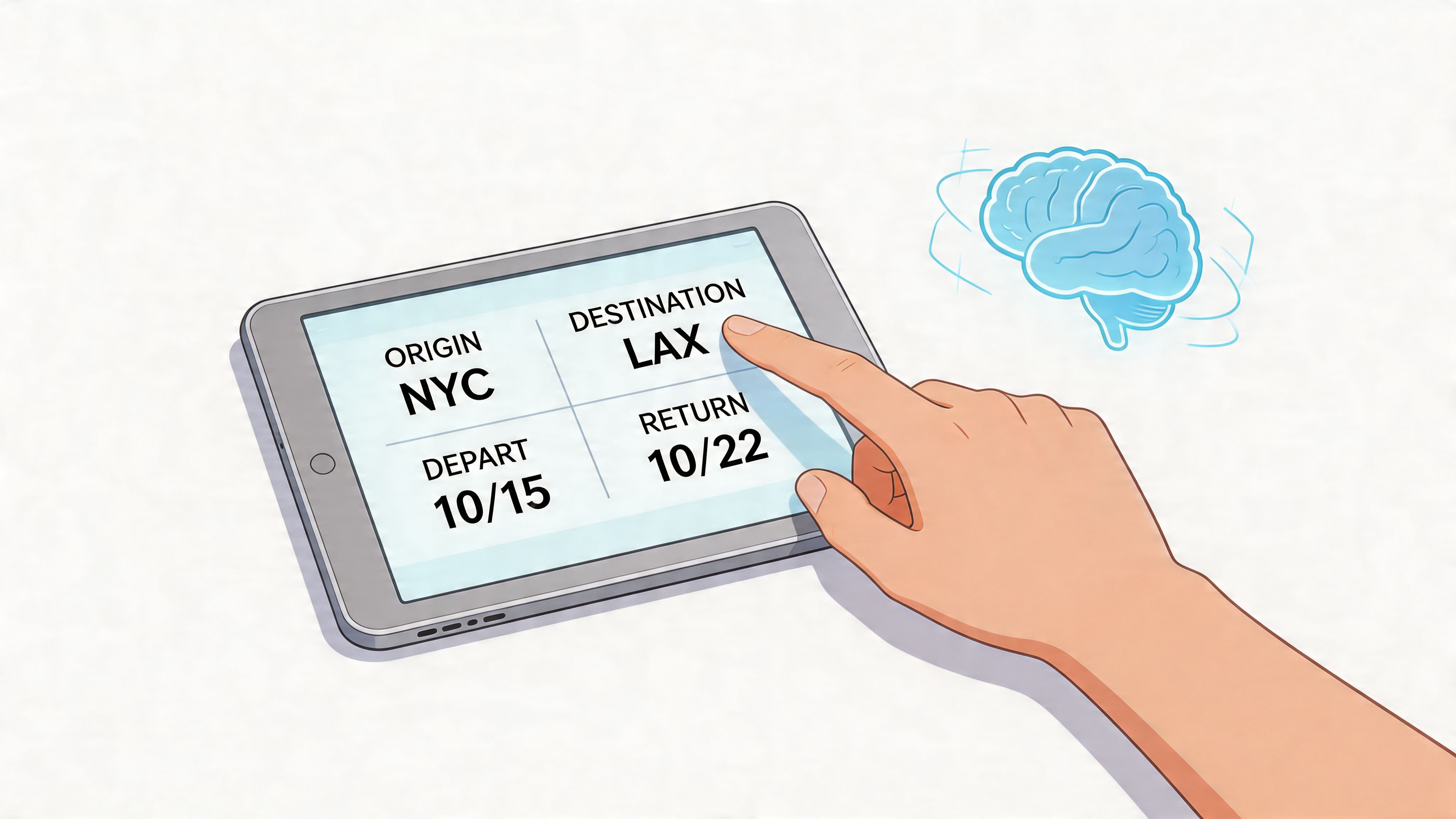
I use a simple booking brief. It should be short enough to send in one message and detailed enough to avoid back-and-forth.
Include:
Flight rules: earliest acceptable departure, latest acceptable arrival, seat type, nonstop preference, baggage assumptions
Hotel rules: neighborhood or venue radius, quality floor, late check-in tolerance, cancellation preference
Ground rules: no car rental, direct transfer preferred, pickup buffer after landing
That structure matters more now because the infrastructure alternatives still aren't ready to simplify this route. The California High-Speed Rail project aims to connect San Francisco and Los Angeles, with a projected 2032 partial service date and a budget exceeding $100 billion, which shows how long and complex large-scale transport solutions can be. For current business travel, agile flight planning still delivers results.
A clean booking workflow
Use a repeatable sequence every time:
Lock the anchor meetings first. Time-sensitive commitments decide the city order.
Book the first flight around the first high-value meeting. Not the other way around.
Choose hotels by next-morning utility. The right hotel is the one that reduces friction at 7 a.m.
Confirm transfer assumptions. Airport to hotel, hotel to meeting, meeting to airport.
Push everything into one calendar view. Transit time belongs on the calendar, not just the meeting itself.
For hotel selection, a dedicated hotel booking flow is most useful when it lets you specify practical constraints such as walkability to venue, quiet rooms, and flexible cancellation, instead of making you re-enter the same requirements across multiple sites.
What works and what doesn't
What works
Booking one city at a time only after the whole route logic is clear
Paying slightly more for schedule resilience when the trip has no slack
Staying near the first meeting, not near the most famous address
What doesn't
Arriving late and assuming you'll still get meaningful evening work done
Booking hotels based on brand loyalty alone
Renting a car "just in case" and then carrying that burden through urban cores
A visual overview helps if you're standardizing this for a team:
The handoff standard
The trip is ready only when one person can glance at a single thread and answer five questions immediately: where you're sleeping, when you're flying, how you're getting into town, what changed, and what tomorrow starts with. If that information is spread around, the itinerary is still half-built.
Mastering Productivity Between Meetings
The profit on a trip like this sits in the margins. Not the flight itself. Not the hotel. It’s the hour after landing, the twenty minutes before a meeting, the ride to the airport, the gap after a cancellation. Most professionals waste those windows because they don't pre-assign them.
San Francisco is a good reminder of why pace matters. Its history was shaped by urgency. The California history overview notes that the Gold Rush grew San Francisco from under 1,000 residents at the start of 1848 to over 100,000 by 1852, a city built around speed, movement, and economic compression. That same pressure shows up in modern business travel there. You feel it the minute the day starts slipping.

Turn transit gaps into fixed-purpose blocks
Don't label open time as "travel buffer" and leave it empty. Give each travel segment a role.
Airport arrival block: clear inbox triage, confirm the first ground transfer, review one briefing doc
Pre-meeting buffer: restroom, reset, venue navigation, final note scan
Post-meeting transfer: voice notes, follow-up tasks, expense capture
Gate time: approvals, summaries, and anything that can be finished without deep context
That approach works because it lowers the cost of interruptions. You already know what each gap is for, so a changed gate or delayed pickup doesn't erase your plan.
Use one command standard for every moving part
The best travelers aren't better at remembering details. They use a consistent operating language with their tools and assistants.
A good command includes:
Action
Time window
Location
Preference
Output
Example in plain English: find a quiet place near the next meeting for a call, move lunch by thirty minutes, and summarize the rest of the day. That's far more useful than hunting manually across maps, email, and calendar while in transit.
If you want a practical framework for structuring your time around actions instead of scattered reminders, this piece on AI for time management is a useful companion.
The travelers who stay calm on this route usually aren’t less busy. They’ve just removed the need to decide everything in real time.
Keep expenses moving while the trip is moving
Expense admin becomes painful when receipts pile up until the return flight. Handle them at point of use.
Try this playbook:
Capture immediately. Forward or scan the receipt as soon as you sit down.
Label while context is fresh. Client meal, airport transfer, hotel incidental.
Tie it to the meeting. If finance asks later, the rationale is already obvious.
Review once nightly. A three-minute check prevents a month-end cleanup session.
Protect cognitive quality, not just clock time
A lot of business travel advice focuses on squeezing more into the day. That’s incomplete. The sharper question is whether you still sound prepared in the fifth conversation.
Use these rules:
Don’t take every call in motion. Some calls deserve a chair, a table, and notes.
Avoid heroic layovers. A tighter itinerary isn't better if one delay ruins the next city.
Reserve one quiet block daily. Even a short protected window helps you think instead of react.
The no-car advantage that matters most
Skipping the car isn't just about avoiding parking or navigation. It preserves mental continuity. You stay in operator mode, not driver mode. That means your transitions can hold actual work, not just logistics.
Putting Your Trip on Autopilot with Superchat
The reason this route overwhelms people is simple. Every change creates three more tasks. A moved meeting means a new airport transfer, possibly a different flight, maybe a later check-out, and a revised calendar. If you handle those one by one, you're already behind.
That’s where a single conversational control layer changes the game. Instead of opening separate tools, you issue one instruction thread and keep the entire trip in context.
Sample commands that actually work
Book a morning flight from San Francisco to Las Vegas on Wednesday, aisle seat only, no departure before 7 a.m. Add a hotel near my conference venue for one night and block transfer time on my calendar.
That request is useful because it contains constraints, not just destinations. It tells the assistant how to choose.
Move my Los Angeles dinner to the earliest slot after my Vegas arrival changes. Keep the same neighborhood, notify attendees, and update the calendar hold.
That’s the kind of follow-through most travelers lose when plans shift. The problem isn't booking. It's coordinated adjustment.
One thread beats a stack of apps
On this circuit, the highest-value capabilities are practical:
Booking with memory: it remembers your seat, hotel, and timing preferences
Calendar coordination: travel time appears where it belongs, alongside meetings
Rescheduling logic: one delay can trigger the next set of changes
Expense visibility: spending stays attached to the trip while you're still on it
This is also where small preparedness details matter. A dead phone can break a well-built itinerary fast, especially when boarding passes, ride details, and hotel confirmations all live digitally. For that reason alone, I recommend keeping a backup battery in your bag. AquaVault’s smart traveler's guide to the best portable charger is a practical read before any multi-city run.
The prompt style to use
Users often are too vague with assistants and then blame the tool. Clear prompts produce good outcomes.
Use this model:
State the route
State the timing
State your essential requirements
State what should happen automatically
For example:
I’m doing san francisco las vegas los angeles next week. Keep every leg nonstop where possible, avoid rental cars, choose hotels close to the first meeting each day, and update my calendar as each booking is confirmed.
If any flight slips enough to affect a meeting, offer the best alternative and draft the attendee update before asking me to approve.
That last line is what autopilot really means. Not blind automation. Coordinated preparation with approval at the right point.
Where this approach pays off
It pays off when the trip changes midstream. It also pays off before the trip starts, because you stop spending mental energy on low-value assembly work. The itinerary becomes a managed conversation instead of a loose collection of screenshots, emails, and half-finished notes.
For assistants, founders, and executives, that's the ultimate upgrade. You aren’t just faster. You’re operating from one source of truth.
Conclusion The Zero-Friction Business Trip
The standard road-trip version of san francisco las vegas los angeles doesn't fit executive travel. The no-car version does. Fly the legs that need precision, sequence the cities by business value instead of map order, and treat bookings, calendar holds, transfers, and expenses as one system.
That’s what reduces friction. Not hustle. Not more tabs. A well-run trip should feel controlled even when it changes. When the travel layer is handled properly, you get your attention back for the work that justified the trip in the first place.
If you want that level of control without juggling separate apps, Superchat turns one conversation into completed travel actions, calendar updates, payments, and follow-ups so your next West Coast run stays tight from booking to return.


