

You land at Suvarnabhumi, switch off airplane mode, and see the calendar reminder you were hoping to ignore. Meeting in Asoke. Not later today. Soon. If you do what most first-time visitors do and head straight for the taxi queue, you’re gambling your first work block on Bangkok traffic.
That’s a bad bet.
If your destination is central Bangkok, makkasan station bangkok is one of the smartest transport decisions you can make. It gives you a cleaner handoff from airport travel to city travel, and it gives you predictability. That matters more than comfort when you’ve got a client waiting, a founder dinner to make, or two site visits stacked before lunch.
I’ve used the airport run both ways enough times to be blunt about it. Taxis are fine when your hotel sits far from the rail network or you’re hauling oversized luggage. For everything else, Makkasan is your tactical move. It’s built around one thing busy people need in Bangkok: getting off the road network fast.
If you’ve ever appreciated a well-run airport transfer somewhere else, you already understand the value of certainty. That’s why practical transfer planning guides like Your guide to smooth Portugal transfers are useful. They focus on the same thing that matters in Bangkok. Remove friction early, and the rest of the trip gets easier. If you want the airport leg sorted before you even board, using a tool that can handle flight booking details also helps keep the moving parts in one place.
Table of Contents
Your Arrival in Bangkok Just Got Faster
What Is Makkasan Station and Why You Should Use It
Why it beats a taxi for core-city trips
The transfer that makes the station useful
Your Step-by-Step Guide to Navigating Makkasan
Start with the right mindset
From Suvarnabhumi to the ARL
Making the Makkasan to Phetchaburi transfer
Connection options at a glance
When to stop using rail and take a car
Sample Itineraries for the Busy Professional
Airport to Sukhumvit with a hard meeting time
Using Makkasan as your working base
The evening airport run without the usual stress
Beyond the Tracks Hotels and Services Near Makkasan
Where to stay
What to look for nearby
The Future of Makkasan HSR and What It Means for You
Why this site matters
What will change for travelers
Essential Makkasan Station FAQs
Is Makkasan only useful for airport passengers
Should I choose Makkasan over a taxi every time
Is the transfer between the ARL and MRT difficult
What’s the biggest mistake first-time users make
Is Makkasan a good base for repeat business trips
Your Arrival in Bangkok Just Got Faster
You’ve got two choices after landing. Join the road traffic immediately, or stay inside Bangkok’s rail logic for as long as possible. For most business trips into the core city, the second option wins.
Makkasan works because it turns the airport run into a controlled sequence instead of an open-ended commute. You take the Airport Rail Link from Suvarnabhumi, get off at Makkasan, cross to the MRT at Phetchaburi, and continue underground to the location of your meeting. That chain is simple enough to repeat without thinking after one trip.
The point isn’t that rail is glamorous. It isn’t. The point is that it’s stable.
Practical rule: If your first stop is near Sukhumvit, Asoke, Silom, Rama 9, or anywhere easily reached by MRT or a short final taxi, go through Makkasan first.
This matters most on arrival day because arrival day is where schedules break. Flights land late. Immigration drags. Bags take too long. Then people try to “save time” with a taxi and lose control of the trip the moment they hit the expressway.
Makkasan gives you a reset point in the city. Once you’re there, you can decide whether to stay on rail, switch to the MRT, or finish with Grab for the last stretch. That flexibility is why seasoned travelers keep using it. It lets you preserve options instead of locking yourself into one expensive, traffic-exposed route from the airport.
If you’re new to Bangkok, remember one thing. The smartest transport choice here usually isn’t the most direct-looking one on the map. It’s the one that avoids surface traffic earliest.
What Is Makkasan Station and Why You Should Use It
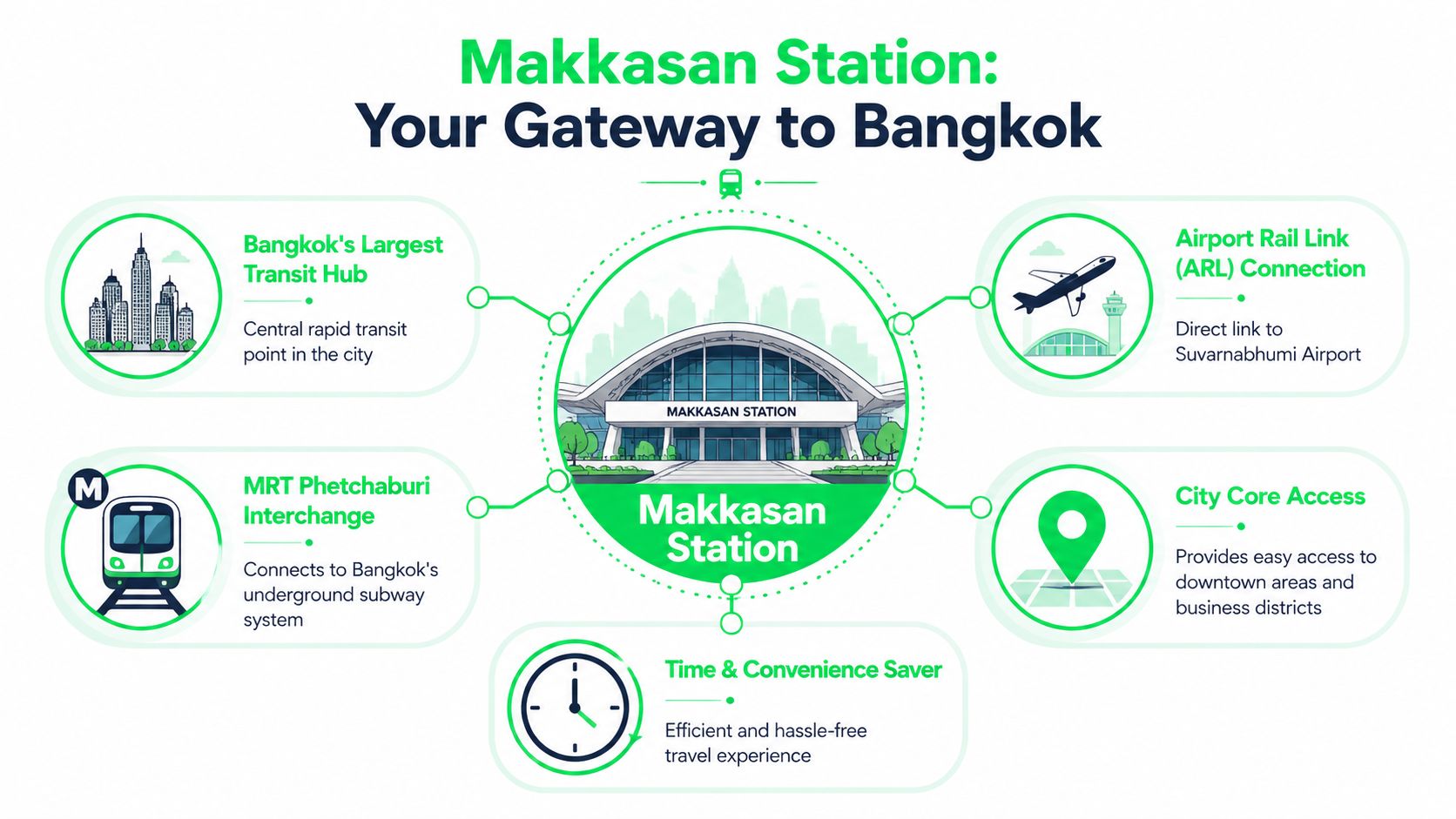
You land at Suvarnabhumi, your phone lights up with meeting changes, and the last thing you need is to gamble an hour on expressway traffic. Makkasan secures its place in your Bangkok routine. It gives you a controlled handoff from airport train to city rail, which is exactly what a tight schedule needs.
Makkasan is the main interchange station on the Airport Rail Link. It was built for throughput, luggage, and transfers, not for wandering foot traffic from a local neighborhood. That difference matters. The station feels oversized because it is meant to absorb airport passengers quickly, then push them onward into the city with less friction and fewer bad decisions.
Why it beats a taxi for core-city trips
For central Bangkok business districts, Makkasan is usually the smarter first move.
A taxi looks simpler on the map. In practice, it ties your entire arrival to road conditions you cannot predict and cannot fix. Makkasan gives you a rail-first entry into the city, then lets you decide the final leg once you are already inside Bangkok’s transit network. That is a better use of time and a better way to protect a meeting schedule.
It works especially well if your first stop is in an area that connects cleanly from the MRT or with a short ride at the end. You stay off the roads for the longest, least reliable part of the trip. That alone is enough reason to use it.
The transfer that makes the station useful
What makes makkasan station bangkok practical is the connection to MRT Phetchaburi. The linked transfer turns one airport rail stop into access to several business zones without forcing you into a taxi too early.
That matters for professionals who need options after landing. If a colleague shifts the meeting from Asoke to Silom, or from Sukhumvit to Rama 9, you are still in good shape. You can stay on rail longer, then finish with a short car ride only if you need one. Anyone who travels for work in Bangkok learns this fast. Flexibility beats a door-to-door plan that falls apart in traffic.
Use Makkasan if you are heading to:
Asoke and Sukhumvit: Reliable for hotels, serviced offices, and dense meeting schedules.
Silom: Practical for finance, legal, consulting, and older office towers.
Ratchada and Rama 9: Strong choice for newer corporate offices, regional teams, and mixed-use business districts.
The bigger point is simple. Makkasan is not just an airport stop. It is a time-management tool. Learn it once, use it well, and every future Bangkok arrival gets easier to coordinate.
Your Step-by-Step Guide to Navigating Makkasan
The first time through, Makkasan can feel bigger than expected. The trick is not to overthink it. Treat it like a transfer operation, not a sightseeing stop.
Start with the right mindset
Makkasan is old and new Bangkok stacked together. The railway station itself is a Class 1 railway station located 5.171 km (3.2 mi) from Hua Lamphong and has served the Eastern Line since January 1908, as noted in the Makkasan railway station history. That long history matters less to your schedule than one practical takeaway: this area has been a rail node for a very long time. People have been moving through it for over a century. Follow the rail logic and the station works.
From Suvarnabhumi to the ARL
Once you’ve cleared the airport formalities, keep the process boring and mechanical.
Head for the Airport Rail Link signs. Don’t freelance this part. Follow the airport wayfinding instead of trying to improvise with ride-hailing apps while standing in arrivals.
Buy the ARL ticket or token. Keep payment simple and move on.
Board the City Line train to Makkasan. If your destination is central Bangkok, this is the decision that gets you out of trouble early.
Get off at Makkasan with purpose. Don’t stop in the concourse to review half your itinerary. Move first, decide second.
If you’re carrying luggage, stay patient around escalators and don’t fight the crowd. Bangkok commuters walk fast, but the transfer is manageable if you stay with the main flow.
Making the Makkasan to Phetchaburi transfer
This is the move that matters most.
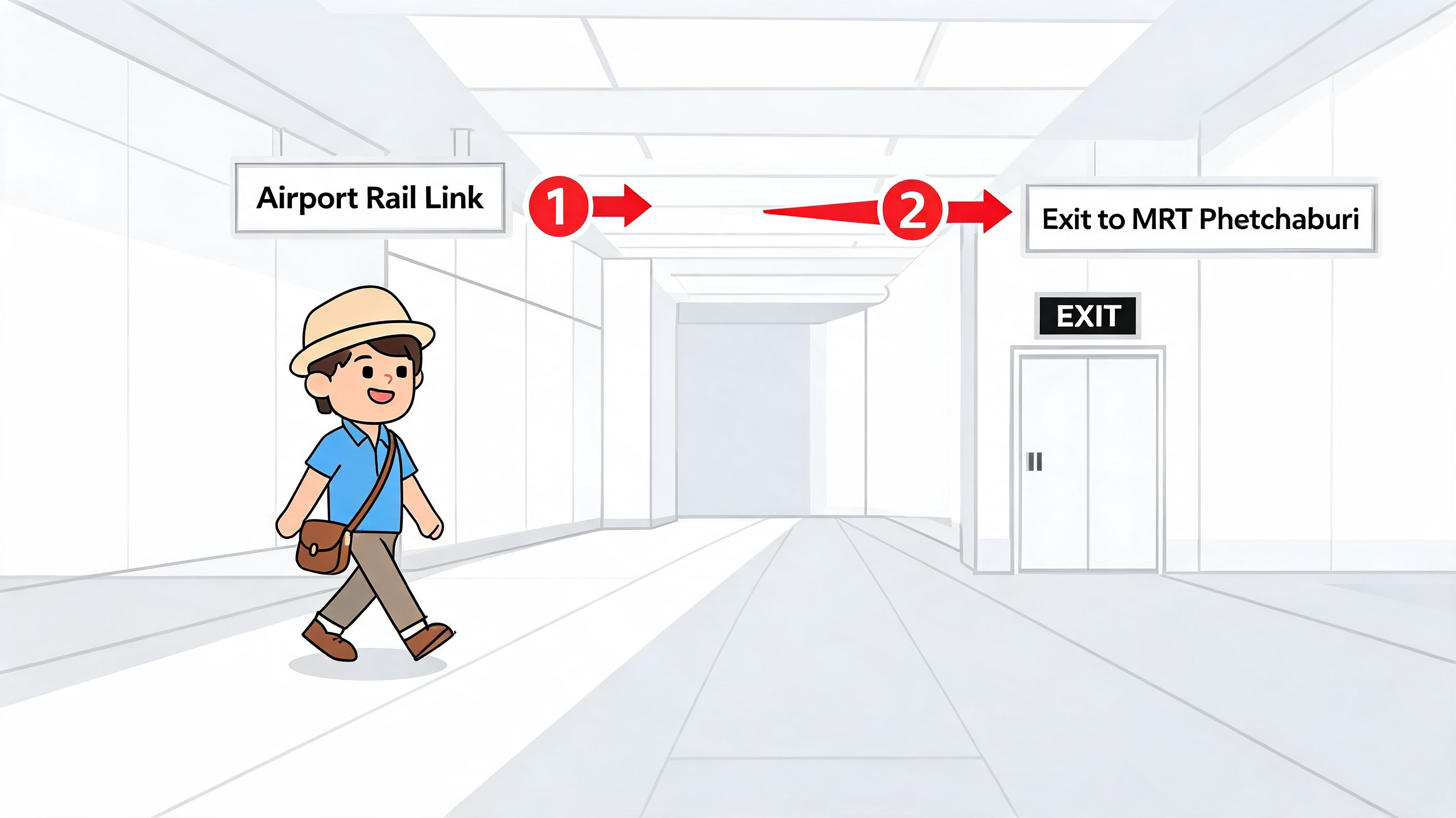
After arriving at Makkasan on the ARL, look for signs to MRT Phetchaburi. The correct play is to use the skywalk connection. It’s the cleanest handoff, protected from street-level chaos, and easier than trying to leave the station and re-enter from road level.
A few practical rules help:
Use signs, not instinct. Bangkok stations often make more sense from the system map than from street geography.
Choose elevators if you’ve got a roller bag and laptop case. You’re not proving anything on the stairs.
Keep your next destination ready before entering the MRT. Decide your station in advance so you’re not blocking the ticket area.
Here’s a quick walk-through if you want a visual before your first transfer:
If you hesitate at Makkasan, you lose time. If you commit to the transfer flow, the station is straightforward.
Connection options at a glance
The table below is for decision-making, not precision timing. Use it to choose the next mode, then check live conditions when you travel.
Mode | Destination | Avg. Time | Est. Cost (2026) | Best For |
|---|---|---|---|---|
ARL | Suvarnabhumi Airport | Fast and predictable | Check current fare at station | Airport runs |
MRT via Phetchaburi | Asoke, Sukhumvit, Silom, Rama 9 | Efficient for core city trips | Check current fare in station system | Meetings near MRT |
Taxi or Grab from Makkasan area | Final off-network destination | Variable with road traffic | Varies by traffic and app pricing | Last-mile travel |
SRT Eastern Line | Eastern corridor destinations | Best planned in advance | Check current rail fare | Regional rail users |
When to stop using rail and take a car
A lot of people make this too ideological. Don’t. Rail is your backbone. Car is your finishing tool.
Use a taxi or Grab from around Makkasan when:
Your meeting is far from rail: Industrial estates, compounds, and some hotels still make more sense by road.
You’re carrying too much gear: One carry-on is easy. Event kits and product cases are not.
The weather turns ugly: Bangkok rain can make even short surface walks annoying.
If you do switch to a car, do it after you’ve already used rail to get into the city. That’s usually the most efficient compromise.
Sample Itineraries for the Busy Professional
What makes Makkasan valuable isn’t theory. It’s how it helps you run a day without padding every journey with “just in case” time. That’s the difference between amateur Bangkok planning and professional Bangkok planning.

Airport to Sukhumvit with a hard meeting time
You land, clear the airport, and your calendar says Asoke. Don’t waste mental energy debating road options. Take the Airport Rail Link to Makkasan, transfer to the MRT at Phetchaburi, and get yourself into the Sukhumvit zone before deciding on the final few blocks.
Many travelers struggle with connection management. While they understand individual transport modes, effectively managing transfers often proves challenging. Makkasan is the interchange, but there’s little guidance on coordinating between the Airport Rail Link, MRT, and future High Speed Rail, creating potential for missed connections, as noted in the Makkasan station overview. If you’re planning a packed trip, it helps to keep the whole sequence organized with a tool that can manage trip planning in one place.
The executive move is simple. Protect the long leg with rail. Leave only the shortest possible segment to road traffic.
Using Makkasan as your working base
If you’ve got meetings spread across several days, staying near Makkasan or on the same MRT corridor is often smarter than staying in the flashiest hotel district. You want flexibility, not just a nice lobby.
A practical pattern looks like this:
Morning meeting near Sukhumvit
Midday return toward the MRT corridor
Afternoon appointment in another central district
Evening airport run or dinner meeting without recrossing the whole city by road
That’s where Makkasan earns its keep. It doesn’t have to be your destination. It just has to be your anchor point. A lot of frequent travelers over-optimize for nightlife or brand-name hotels and under-optimize for transfer logic. That’s backward if you’re working.
Stay where your first and last journey of the day are easiest. Everything else gets easier from there.
The evening airport run without the usual stress
Departure day is where people suddenly become conservative. They leave absurdly early because they don’t trust Bangkok traffic. Fair enough. But if you’re based in the core city, the Makkasan route gives you a steadier way back to Suvarnabhumi.
The smart routine is to get yourself to the MRT first, transfer at Phetchaburi, then board the ARL from Makkasan with your airport segment already de-risked. You avoid the classic problem of sitting in a car watching your buffer disappear.
This also changes how you plan the last day. You can still take a lunch meeting, work from a café, or do one final office stop if you know your airport route is rail-led instead of traffic-led. That’s luxury in Bangkok. Not comfort. Control.
Beyond the Tracks Hotels and Services Near Makkasan
Choosing where to stay around makkasan station bangkok is less about being “close to the station” and more about reducing the number of bad transport decisions you’ll make when you’re tired. A nearby hotel with easy rail access beats a prettier property that traps you in daily car trips.
Where to stay
Look for hotels in the Makkasan, Phetchaburi, Asoke, and Rama 9 corridor. That gives you options. You can walk, use a short car ride, or jump straight onto rail depending on the day.
Prioritize these features:
Reliable in-room Wi-Fi: If a hotel is vague about internet quality, take that as a warning sign. For anyone evaluating what good hotel connectivity should look like, this overview of Cisco Meraki hotel WiFi solutions is useful because it shows the operational side of dependable guest internet.
Early breakfast or grab-and-go coffee: Morning meeting days don’t wait for leisurely service.
Fast check-in and check-out: You don’t want front-desk friction on airport days.
Meeting-friendly common areas: Useful for informal catch-ups between appointments.
If you want booking logistics handled cleanly, using a tool that can organize hotel booking details helps keep confirmations, dates, and changes from getting scattered across apps.
What to look for nearby
Don’t obsess over attractions. Focus on workflow.
You want a base with easy access to coffee, a convenience store, laundry, and somewhere quiet enough to take calls. If you can walk to one decent café and one practical lunch option, that’s usually enough. Bangkok gives you endless choice, but too much choice wastes time when you’re working.
A good Makkasan-area setup feels unglamorous in the best possible way. You sleep well, move fast, and don’t spend the trip recovering from your own transport plan.
The Future of Makkasan HSR and What It Means for You
A year from now, you may land in Bangkok for a morning meeting, change airports the same day, and use Makkasan as the point that keeps the whole schedule intact. That is why this station matters beyond the usual airport run.
Why this site matters
Makkasan is tied to Thailand’s high speed rail plan linking three airports. For business travelers, the practical takeaway is simple. If the project delivers as intended, Makkasan stops being just a useful airport rail stop and becomes a stronger transfer node for combining city meetings, airport changes, and regional travel in one plan.
That matters if your Bangkok trips involve more than one flight leg, cross-city appointments, or colleagues arriving through different airports. A stronger Makkasan hub would cut coordination waste. It gives you one clearer handoff point instead of scattered taxi pickups and guesswork.
What will change for travelers
The station area will likely get more useful and more confusing at the same time.
Public planning and urban redevelopment material around Makkasan points to a large, evolving transport site with adjacent systems, phased construction, and changing access patterns. The Makkasan case study report describes the area as a major redevelopment zone rather than a finished, traveler-first interchange. Treat it that way.
Here is the smart approach:
Recheck station access before each trip. Entrances, pickup points, and pedestrian routes can change faster than blog posts do.
Protect your transfer window. If your schedule depends on rail plus another flight or meeting, add buffer time on purpose.
Set one meeting point with colleagues in advance. Do not improvise inside a changing station footprint.
Keep a fallback option. If a transfer path is blocked or crowded, know your taxi or rideshare backup before you arrive.
This is really a time-management story. Travelers who plan Makkasan as a fixed coordination point will get more out of it than travelers who treat every leg separately and solve problems on the fly.
The upside is clear. Learn Makkasan now, and you will be ahead of the crowd once the HSR buildout starts changing how Bangkok connects its airports and business districts.
Essential Makkasan Station FAQs
Is Makkasan only useful for airport passengers
No. Airport passengers get the obvious benefit, but the station is also useful if you’re structuring meetings around the MRT corridor and want a reliable connection point. Think of it as a transport hinge between airport travel and central Bangkok.
Should I choose Makkasan over a taxi every time
No. Choose Makkasan when your destination is on rail or close enough that a short final car ride makes sense. Choose a taxi when your endpoint is awkward, luggage is excessive, or you’re traveling with colleagues who need a direct door-to-door run.
Is the transfer between the ARL and MRT difficult
Not really, but it punishes hesitation. If you follow signs to Phetchaburi and keep moving, it’s straightforward. Travelers get into trouble when they stop to orient themselves too often or leave the station flow unnecessarily.
What’s the biggest mistake first-time users make
They treat every leg as a separate problem. Bangkok rewards joined-up planning. Decide the airport leg, transfer leg, and final leg before you start. That’s what keeps you from paying for convenience and still arriving late.
Is Makkasan a good base for repeat business trips
Yes, especially if your work keeps you in the central city and you value predictable airport access. It won’t be the right answer for every itinerary, but it’s one of the best repeat-use nodes to learn if Bangkok is part of your regular circuit.
If your days involve flights, hotels, calendars, payments, and constant rescheduling, Superchat is built for exactly that mess. It helps you keep bookings, plans, and changes in one private thread so you spend less time juggling apps and more time staying ahead of your schedule.


