
You’ve got a gap between meetings, maybe a dinner to schedule, maybe a flight later out of Norfolk International. You need one place that lets you eat well, answer email, walk a few blocks, and still feel like you saw the city. Granby St Norfolk is usually the right answer.
For a busy professional, that matters more than charm alone. Downtown can either waste your time or compress your day in a useful way. Granby Street works when you use it with a plan: pick the right block, avoid the wrong parking assumptions, and know when construction will change the math on travel time.
Table of Contents
Your Introduction to Downtown Norfolk's Central Hub
The Story of Granby Street From Boom to Modern Hub
What the boom years looked like
Where the decline set in
How Granby became useful again
Top Restaurants and Hotels for the Discerning Traveler
Power lunch spots
Client dinners that still feel Norfolk
Business-ready hotels
The efficient way to choose
Granby Street as a Business and Innovation Corridor
Why the corridor works for professionals
The Assembly shows the model clearly
Getting Around Granby Street: Parking, Transit, and Construction
Parking strategy that actually saves time
Transit options that make sense downtown
Construction through 2025 and 2026
Crafting Your Perfect Granby Street Itinerary
Four hour business layover
Post conference evening
Events Nightlife and Visitor FAQs
What to expect after work
Common questions from visitors
Your Introduction to Downtown Norfolk's Central Hub
A common Norfolk workday scenario goes like this. You finish a meeting downtown with two or three usable hours left, and you don’t want to burn them sitting in a generic lobby or wandering through blocks that don’t connect. You need lunch, decent coffee, a place to regroup, and maybe a short walk that feels local rather than manufactured.
That’s where Granby Street earns its keep. It functions as downtown Norfolk’s central spine for professionals because it compresses multiple needs into one walkable stretch: meals, hotels, offices, restored architecture, and enough street activity to make a short visit feel productive rather than idle.
The trick is not to treat Granby Street like a sightseeing list. Treat it like an operating base. If you’re handling a client lunch, you want a spot where service is steady and the room doesn’t fight conversation. If you’re solo between appointments, you want somewhere you can sit down, answer messages, and step back out without losing momentum.
Practical rule: On Granby Street, convenience beats novelty when your schedule is tight. Choose places that keep you within a short walk of your next commitment.
Granby also gives you something many business districts fail to deliver. It has actual context. The buildings, side streets, and public spaces tell you you’re in Norfolk, not in an interchangeable downtown. That makes the street useful for both business and leisure. You can take a client to dinner, then walk a block or two and point out a theater, a historic facade, or a pocket of nightlife without forcing the evening.
If your goal is to make the most of limited time, Granby Street is less about checking boxes and more about reducing friction. That’s the standard this guide uses.
The Story of Granby Street From Boom to Modern Hub
You can feel Granby Street’s history in a ten-minute walk. A block that works for a quick coffee meeting sits beside older storefronts built for a much bigger retail economy, and that contrast explains a lot about how downtown Norfolk functions now.
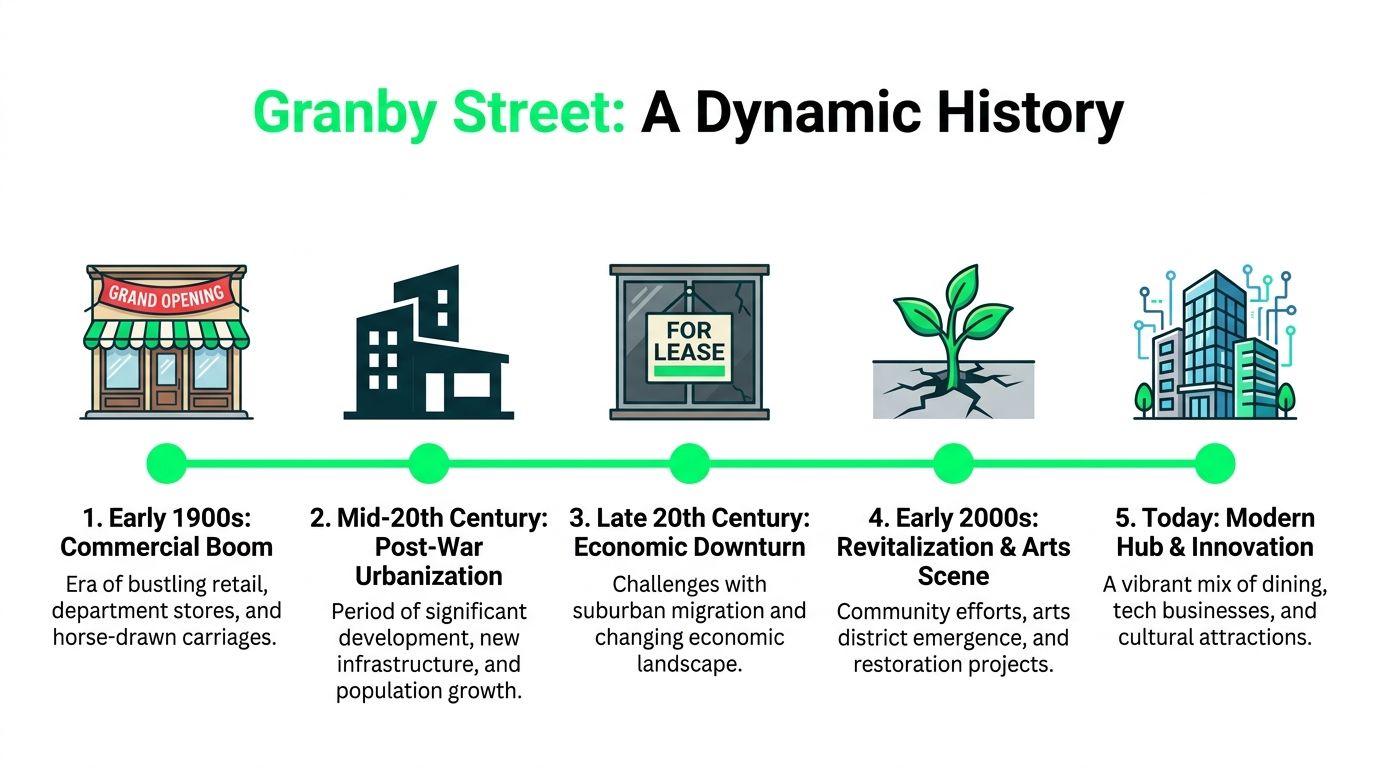
Granby Street dates to 1769, when it was named for John Manners, the Marquess of Granby. Its real commercial rise came later, as Norfolk expanded in the late 19th and early 20th centuries. The arrival of electric streetcars reshaped how people moved through the city, and Granby grew into Norfolk’s primary shopping street by the early 1900s, as noted on the Granby Street historical marker.
What the boom years looked like
At its peak, Granby was not a narrow downtown strip with a few local shops. It was a serious retail corridor with variety stores, department stores, theaters, and enough foot traffic to pull shoppers from well beyond the immediate downtown. That scale still shows up in the street wall. Some buildings have wider fronts, taller ceilings, and a presence that only makes sense once you remember they were built for heavy commercial demand.
For a busy visitor, that history is useful because it explains the street’s present layout. Granby has the bones of a major business district, not a boutique side street. That is why it can still handle lunch meetings, hotel traffic, office workers, and evening crowds within a compact area.
Where the decline set in
Like many downtowns, Granby lost ground when shoppers followed easier parking and newer suburban retail. Norfolk’s answer was ambitious. The city converted part of the corridor into the pedestrian-focused Granby Mall for about a decade in the late 20th century.
The idea looked good on paper and worked less well in daily use. Downtown needs walkability, but it also needs practical access. Cut off the easy in-and-out trip, and you lose office workers, errand traffic, and some of the lunch business that keeps a corridor active during the day.
That trade-off still matters if you are planning time on Granby now, especially with 2025 and 2026 construction work set to affect parts of downtown circulation. Street improvements can help long term, but during active work periods the best strategy is simple. Build in a few extra minutes, park once when possible, and avoid assuming the fastest route on a map will be the fastest route on the ground.
Granby works best when access, foot traffic, and mixed-use activity stay in balance.
How Granby became useful again
The recovery came from reconnecting downtown to everyday use. New residential demand, institutional anchors, entertainment venues, and later redevelopment gave Granby a job again. It stopped relying on nostalgia and returned to being a place where people had reasons to be throughout the day.
That matters more than the usual before-and-after story. A street becomes durable when it serves several routines at once: work, dining, events, errands, and overnight stays. Granby does that now, which is why it works well for professionals who need one district to cover multiple tasks without wasted movement.
If you are fitting meals into a packed day, it helps to review restaurant options by cuisine and schedule before you arrive. On Granby, a good choice is rarely the flashiest room. It is the one that keeps your day on time.
The result today is a corridor with memory and function. You are not looking at a preserved set piece. You are using a downtown street that learned what convenience, density, and daily demand require.
Top Restaurants and Hotels for the Discerning Traveler
If your calendar is packed, you don’t need a long list. You need a short list with a clear use case. On Granby Street and the surrounding downtown blocks, the best choices are the ones that match the meeting in front of you.
Power lunch spots
For a midday meeting, prioritize speed, audibility, and menu range. You want a place where one person can order light and another can order a full meal without turning lunch into a negotiation.
A few reliable patterns work well on or near Granby. Hotel dining rooms are often the safest option when timing matters. They’re built for predictable pacing and are used to solo travelers, business pairs, and short windows between appointments. Casual downtown spots can also work if you know the room and avoid peak crush times.
Fast in and out: Choose a casual lunch spot when the goal is efficiency and not theater. This works best for internal meetings or catchups with colleagues.
Conversation first: Pick a quieter room with stable table service if you need to review numbers, contracts, or next steps.
Solo reset: A cafe setup is better than a full-service restaurant when you need to answer email before moving to the next stop.
If you’re narrowing restaurant options before you arrive, a tool that organizes choices by cuisine, timing, and convenience can save a surprising amount of time. That’s where restaurant planning for busy schedules is useful.
Client dinners that still feel Norfolk
At dinner, the standard changes. You’re not just buying food. You’re choosing a room that signals judgment. Granby Street is strong here because it doesn’t force you into one style. You can keep it polished, go modern, or choose something a little more local and relaxed.
What works:
A restaurant with a composed but not stiff atmosphere: Better for clients who travel often and don’t need a ceremonial meal.
Walkable proximity to hotels or entertainment: Easier to extend the evening naturally.
A setting with visible downtown character: Historic streetscape and theater proximity do some of the hosting for you.
What usually doesn’t work:
The loudest room on the block: Energy is good, but if people lean forward every five minutes to hear, the dinner is doing less work for you.
A place that’s great for locals but hard for visitors to decode: If parking, entry, or menu structure creates confusion, the meeting starts with friction.
Business-ready hotels
For lodging, location matters more than amenities lists. If you’re in downtown Norfolk for work, staying close to Granby Street cuts down on decision fatigue. You can walk to meals, meet people in the lobby, and avoid extra rides for things that should take ten minutes.
Use this quick comparison as a decision filter.
Establishment | Category | Price Point | Key Feature |
|---|---|---|---|
Downtown full-service hotel | Hotel | Upper-mid to upscale | Best for predictable business travel routines |
Boutique downtown hotel | Hotel | Upscale | Better for client-facing stays and a stronger sense of place |
Casual Granby-area lunch cafe | Dining | Moderate | Good for solo work blocks and informal meetings |
Polished downtown dinner restaurant | Dining | Moderate to upscale | Best for client dinners and post-meeting debriefs |
The efficient way to choose
Busy travelers often over-index on online buzz and under-index on logistics. On Granby, a slightly less exciting restaurant that’s close to your hotel and easy to exit can be the better professional choice.
Local advice: If you’ve got one important meal, spend your decision-making energy on dinner. For lunch, optimize for pace and proximity.
The same applies to hotels. If the property lets you walk to Granby Street, handle a coffee meeting nearby, and get back out without a car shuffle, it’s doing its job.
Granby Street as a Business and Innovation Corridor
You finish a client lunch on Granby, need a quiet place for a follow-up meeting, and still have time to walk to a second appointment without calling a car. That kind of schedule only works in districts built for more than nightlife. Granby Street earns its keep during business hours because the office stock, street activity, and nearby institutions all support a full workday.

Why the corridor works for professionals
Granby performs well as a business address for a simple reason. It gives professionals density without the friction of a larger downtown. Meetings, coffee stops, hotel lobbies, and civic venues sit close enough together that you can protect your calendar instead of spending half the day in transit.
That matters more than branding language. A corridor can have attractive buildings and still fail the working test if the blocks empty out, lunch options are weak, or the office inventory feels dated. Granby avoids that trap because its revival came from a mix of reuse projects, public investment, and steady downtown activity rather than one flagship tower.
The result is useful, not flashy. Historic commercial buildings still give the street character, but many of the better properties have been updated in ways office users find valuable: flexible layouts, modern systems, and a setting that makes it easier to host people from out of town.
The Assembly shows the model clearly
If you want one address that explains Granby's business case, start with The Assembly at 400 Granby Street. The LoopNet listing for The Assembly describes a former department store from 1910 that was redeveloped into a five-story office campus, with post-tensioned slabs for open-plan flexibility, VRF systems aimed at stronger energy performance, and post-opening occupancy that indicates the concept found real tenant demand.
That combination is the point. Granby's better office projects keep the parts people remember and update the parts tenants use every day. For employers, that creates a practical middle ground between generic new space and older buildings that look good in photos but fight you on layout, comfort, or infrastructure.
Before you watch the street in motion, it helps to see how the district presents itself visually.
For a busy professional, the trade-off is straightforward. Granby is not the place to expect a suburban office park experience with effortless car access at every door. It is a better fit for firms and travelers who value walkability, quick meeting transitions, and a downtown address that feels active after 5 p.m.
That balance is why the corridor holds up for leasing, short business trips, and client-facing days. If your schedule depends on staying mobile, park once, keep your meetings clustered, and use a parking coordination tool for downtown stops before peak lunch or event hours. The next two years will also matter. Construction work tied to downtown improvements in 2025 and 2026 may change the fastest routes and curb access on short notice, so anyone booking tight meeting windows should build in a little buffer rather than assuming today's traffic pattern will hold.
Getting Around Granby Street: Parking, Transit, and Construction
You can lose 20 minutes on Granby before the day even starts. It usually happens the same way. A driver chases a curb spot, misses the easiest garage entrance, then gets caught by a detour or event traffic and arrives rushed.
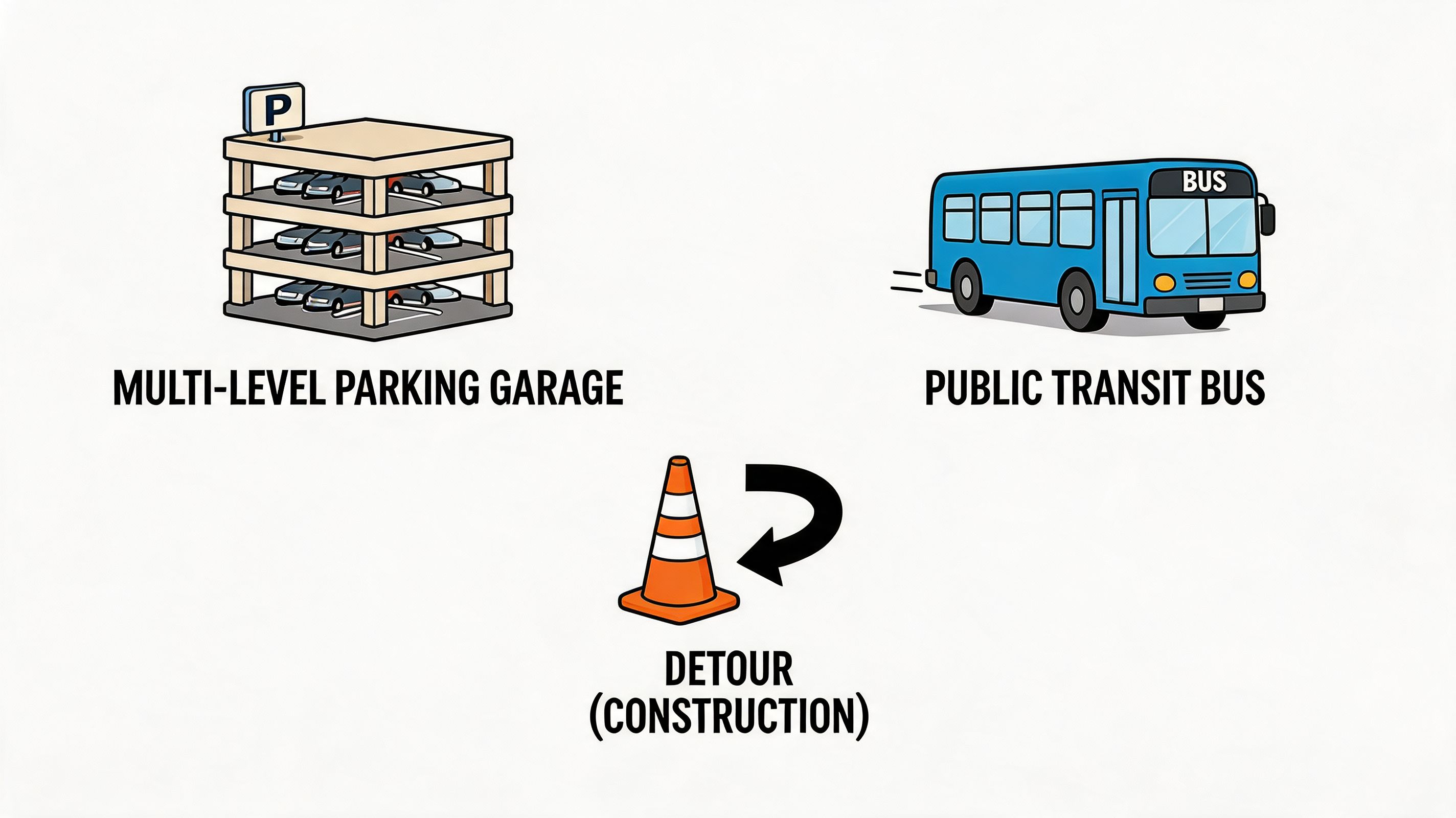
Granby works best if you treat it like a compact downtown district, not a strip of door-to-door stops. Park once, keep your appointments tight by block, and stay on foot as long as possible. That is usually the fastest play for lunch meetings, hotel check-ins, and short client visits.
Parking strategy that actually saves time
A garage beats circling for the perfect meter almost every time. The best choice is usually the one with an easy in-and-out route, even if it adds a short walk.
Use a simple rule set:
Park near your longest stop. If lunch is your anchor meeting, start there and build the rest of the visit around that block.
Skip the hunt for curbside parking. One extra block on foot is cheaper than ten extra minutes behind the wheel.
Check access before you leave your first stop. If your day includes two or three downtown commitments, a parking assistant for trip coordination helps you avoid last-minute garage changes and meter guesswork.
For business travel, boring is good. You want parking that disappears from the day once you lock the car.
Transit options that make sense downtown
The Tide can help if your schedule includes other downtown stops and you do not need your car at each one. It is most useful for visitors staying nearby, attending an event, or pairing Granby with meetings elsewhere in the core.
Rideshare also has a place here, but timing matters. On busy evenings, pickup points can slow down around the entertainment blocks. If your meeting ends close to dinner service or before a major event, order early and walk to a calmer pickup point if needed.
Construction through 2025 and 2026
The bigger scheduling issue is street work. Norfolk's Granby Street corridor improvements are set to run from July 2025 through March 2026, with lane changes, bike lane work, and pedestrian upgrades affecting how drivers approach parts of downtown, according to the City of Norfolk project page.
For a busy professional, the practical takeaway is simple. Build buffer into every arrival, especially if you are coming in from outside downtown and trying to hit a fixed lunch reservation or a first meeting of the day. The corridor should be better on foot after the work is done. During active construction, speed will come from planning your sequence well, not from trying to outguess every detour.
A tighter operating plan helps:
Cluster meetings on the same side of downtown where possible.
Avoid back-to-back commitments that force cross-corridor driving.
Check your outbound route before asking for the bill or heading to valet.
Give yourself a recovery window before client-facing meetings.
If you are building a half-day around Granby, the MLR Worldwide Service travel template is a useful way to map arrival time, parking choice, meeting order, and construction buffer without overcomplicating the plan.
Crafting Your Perfect Granby Street Itinerary
You don’t need a full day to get value out of Granby Street. You need a sequence that respects time, walking distance, and the kind of energy you want from the visit.
Four hour business layover
Start with lunch, not coffee. A proper meal gives structure to the window and lets you settle before deciding whether the rest of the block belongs to work or wandering.
A strong four-hour pattern looks like this:
First hour: Lunch at a reliable downtown spot where service is steady and the room is calm enough for notes or follow-up messages.
Second hour: Walk Granby Street and adjacent downtown blocks for a short cultural reset. The architecture and street activity are enough to make the stop feel local without turning it into a museum day.
Third hour: Take a seat at a cafe or hotel lobby and clear inbox, return calls, or prep the next meeting.
Final stretch: Head back to your garage, rideshare pickup, or airport route early rather than squeezing in one extra stop.
A planning template offers a practical solution. If you regularly build short work-travel windows, the MLR Worldwide Service travel template is a practical way to organize transitions, buffer time, and key reservations without overcomplicating the day.
Post conference evening
After a conference or long meeting day, Granby Street is better used as a decompression corridor than a marathon. Start with a drink or light bite within walking distance of your hotel or venue. Then move to dinner somewhere that lets the evening feel intentional.
A clean sequence usually works best:
Happy hour near your first stop: Keep the walk short and the reset easy.
Dinner with some atmosphere: Granby offers visitors its best atmospheric dinner experiences.
One optional add-on: A theater, a walk, or a final coffee. Don’t stack too much after dinner unless the evening is social by design.
If you’re building the trip around multiple meetings, hotel check-ins, and changing arrival times, use a tool that can keep the schedule coherent. A trip planning assistant for busy travelers is useful when your evening plan has to flex around the rest of the day.
The key mistake people make is trying to “do” Granby Street all at once. Don’t. The street is best in compact doses. A smart lunch window or a clean evening loop tells you more about downtown Norfolk than an overstuffed itinerary ever will.
Events Nightlife and Visitor FAQs
You finish a late meeting near downtown, have 90 minutes before the next obligation, and need an evening that feels useful instead of random. Granby Street works well in that slot. It gives you enough choice to turn a workday into a solid dinner, a quick drink, live entertainment, or a short reset before bed without wasting time on long transfers.
What makes the area useful is density. Restaurants, bars, performance venues, and hotels sit close enough together that you can make decisions on the fly and still keep the night efficient. For a busy traveler, that matters more than chasing one headline attraction.
Granby also makes more sense if you treat it as a compact downtown district with a real civic and cultural backdrop, not just a row of places to eat. As noted earlier, the street sits within a broader historic core, which helps explain why the area feels more layered than a standard entertainment strip.
If your Norfolk stop is part of a longer trip, it may help to plan your dream vacation around the region rather than limiting yourself to downtown alone.
What to expect after work
Early evening is usually the sweet spot. You still get energy on the street, but you avoid some of the late-night friction that comes with heavier bar traffic, slower rideshare pickups, and longer waits at popular spots.
The best approach is to pick one clear lane for the night. Do dinner and one drink. Catch a show and keep the meal simple. Meet clients for a short social stop, then call it. Granby rewards restraint.
That matters even more over the 2025 to 2026 project cycle. If street work, utility work, or downtown access changes affect your visit, build in extra transfer time after dark and confirm parking access before you leave the office or hotel. A place that is easy at 5:30 can become less convenient later if a garage entrance shifts or a block is temporarily restricted.
Common questions from visitors
Is Granby Street good for walking at night?
Yes, in the active downtown blocks where restaurants, venues, and foot traffic stay consistent. Use the same judgment you would in any city center. Keep to the busier stretches, know your next stop before you leave the current one, and avoid drifting into quieter blocks just because they look close on the map.
Is it family-friendly?
During the day and into early evening, yes. Meals, short walks, and event-based outings work well. Later at night, the tone shifts toward bars and adult social traffic, so families usually get the best value earlier.
What’s the best time to visit?
For working travelers, lunch, early dinner, and pre-event windows are strongest. You get the best mix of convenience and atmosphere when the street is active but not at full nightlife volume.
What should first-time visitors avoid?
Overpacking the night. Also avoid assuming every parking option will be equally quick, or that your preferred route will stay unchanged during upcoming construction periods. Check access, make one or two firm choices, and leave some buffer. That usually produces a better evening than trying to cover half the district.
If you want one tool to keep your Granby Street visit organized, Superchat can help you line up reservations, parking, timing, and schedule changes in one place so the day runs cleanly from meeting to meal to departure.


