
You’ve got one free day, maybe a Saturday between meetings, family obligations, and a phone that won’t stop buzzing. You want the Delaware Water Gap without the classic failure mode: late arrival, full lots, circling traffic, and a hike that starts with irritation instead of fresh air.
That’s where the delaware water gap park and ride earns its place. If your goal is a clean, low-friction day trip, the smartest move isn’t finding the “best” trail first. It’s locking down your parking and shuttle plan before you leave home. Do that well, and the rest of the day gets much easier.
Table of Contents
Why You Need a Parking Strategy for the Delaware Water Gap
Why direct-to-trailhead parking often fails
What works better
Your Guide to the Official Delaware Water Gap Park and Ride Lots
Where to aim your GPS
What the lot is good for
What to expect on arrival
Mastering the Delaware Water Gap Shuttle System
The shuttle schedule that matters most
How to use it without wasting time
Who benefits most
Pro Tips for a Seamless Trip
Three efficient day plans
Pack for transitions, not just the trail
The local-expert trade-off
Exploring Your Other Transportation Options
Transportation options at a glance
When the alternatives make sense
Quick Fixes for Common Parking and Shuttle Problems
If the lot is fuller than expected
If you miss a shuttle
If accessibility details are unclear
If you need one last local rule
Why You Need a Parking Strategy for the Delaware Water Gap
The most common mistake at the Gap is treating parking like a detail. It isn’t. It’s the variable that decides whether your trip feels smooth or scrambled.
In 2024, Delaware Water Gap National Recreation Area welcomed 4.1 million visitors, and visitor spending contributed $211 million to the local economy, according to the National Park Service visitor spending report. That level of use is great for the region. It also means the obvious access points get stressed fast.
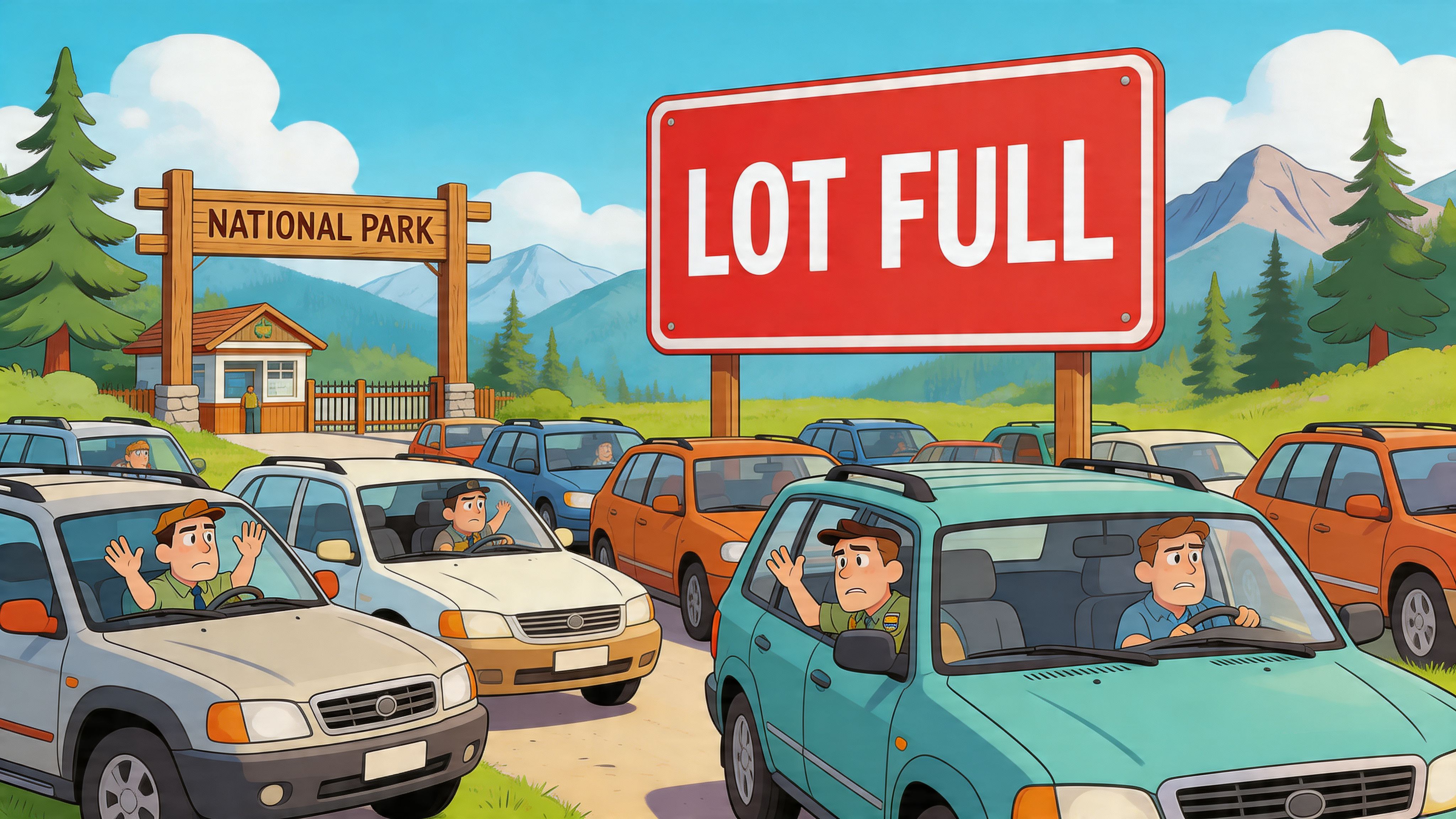
If you arrive casually on a good-weather weekend, you’re competing with hikers, paddlers, scenic drivers, and people squeezing in a short outing from the New York and Philadelphia sides. The result is predictable: full trailhead lots, backups near the most popular stops, and time lost before you even start walking.
Why direct-to-trailhead parking often fails
For a busy professional, the problem isn’t only inconvenience. It’s schedule drift.
You lose your best hours: The early part of the day is when parking is easiest and trails feel least chaotic.
You burn energy on logistics: Circling for a space turns a day trip into a chore.
You narrow your options: Once a lot fills, your “flexible” plan becomes reactive.
Practical rule: If you care about efficiency, treat parking like a reservation mindset, even when the lot itself isn’t a reservation system.
The park-and-ride approach solves a specific problem. Instead of racing everyone else to the same trailhead, you leave your car at a known access point and let the shuttle handle the last leg. That’s especially useful when your day has a hard stop, such as needing to be back on the road by late afternoon.
What works better
The people who have the best Delaware Water Gap days usually do three things well:
They pick a lot first, then an activity.
They build around shuttle timing instead of guessing.
They avoid peak arrival uncertainty at trailheads.
That’s the key value of the delaware water gap park and ride. It isn’t glamorous. It’s efficient. And in a park this busy, efficient wins.
Your Guide to the Official Delaware Water Gap Park and Ride Lots
If you want the lowest-friction setup, focus on the official park-and-ride used with the Monroe County Transit Authority shuttle network. This is the practical starting point for people who want to park once and stop thinking about the car.
Where to aim your GPS
The key reference point is the Park and Ride at Exit 310 off I-80, identified in official shuttle materials for Delaware Water Gap services. If you’re coming by highway, this is the simplest navigation target because it removes the guesswork that comes with smaller trailhead approaches and seasonal access quirks.
Older park materials describe the lot as free, and the same official guide notes 100+ spaces at the park-and-ride, along with its role as a base for shuttle-linked access to hiking and paddling routes in the area.
Get the parking piece sorted before you leave. If you already use digital tools for travel logistics, a consolidated workflow like car parking planning support is useful for keeping route notes, reminders, and trip details in one place.
What the lot is good for
This lot is best for visitors who want structure, not spontaneity. That includes:
Weekend hikers who don’t want to gamble on direct trailhead parking
Paddlers who need a cleaner shuttle-to-put-in setup
Small groups meeting in one vehicle before heading into the park
Commuter-adjacent visitors fitting the Gap into a larger regional drive
The park-and-ride is especially useful because it connects to the shuttle system serving high-demand areas. That matters when popular trailheads start feeling crowded early in the day.
What to expect on arrival
Don’t expect resort-style amenities. Expect utility.
Use this lot as a staging point, not as part of the experience itself. Arrive with your water filled, your layers sorted, and your route decision already made. The smoother your prep in the lot, the better the rest of the day goes.
A simple arrival checklist helps:
Open your route before you park: Cell service can be uneven depending on where you continue into the recreation area.
Stage gear once: If you’re carrying trekking poles, paddles, or bike gear, organize it at the car instead of repacking at the shuttle stop.
Know your return logic: Decide whether you’re coming back by shuttle, on foot, or via group pickup before you leave the lot.
A lot of visitors overcomplicate this. You don’t need a clever plan. You need a reliable one. For most day-trippers trying to protect their time, the official delaware water gap park and ride is that plan.
Mastering the Delaware Water Gap Shuttle System
The shuttle is what turns the park-and-ride from a parking workaround into a real strategy. Used well, it lets you skip the trailhead scramble and build a day that runs on time.
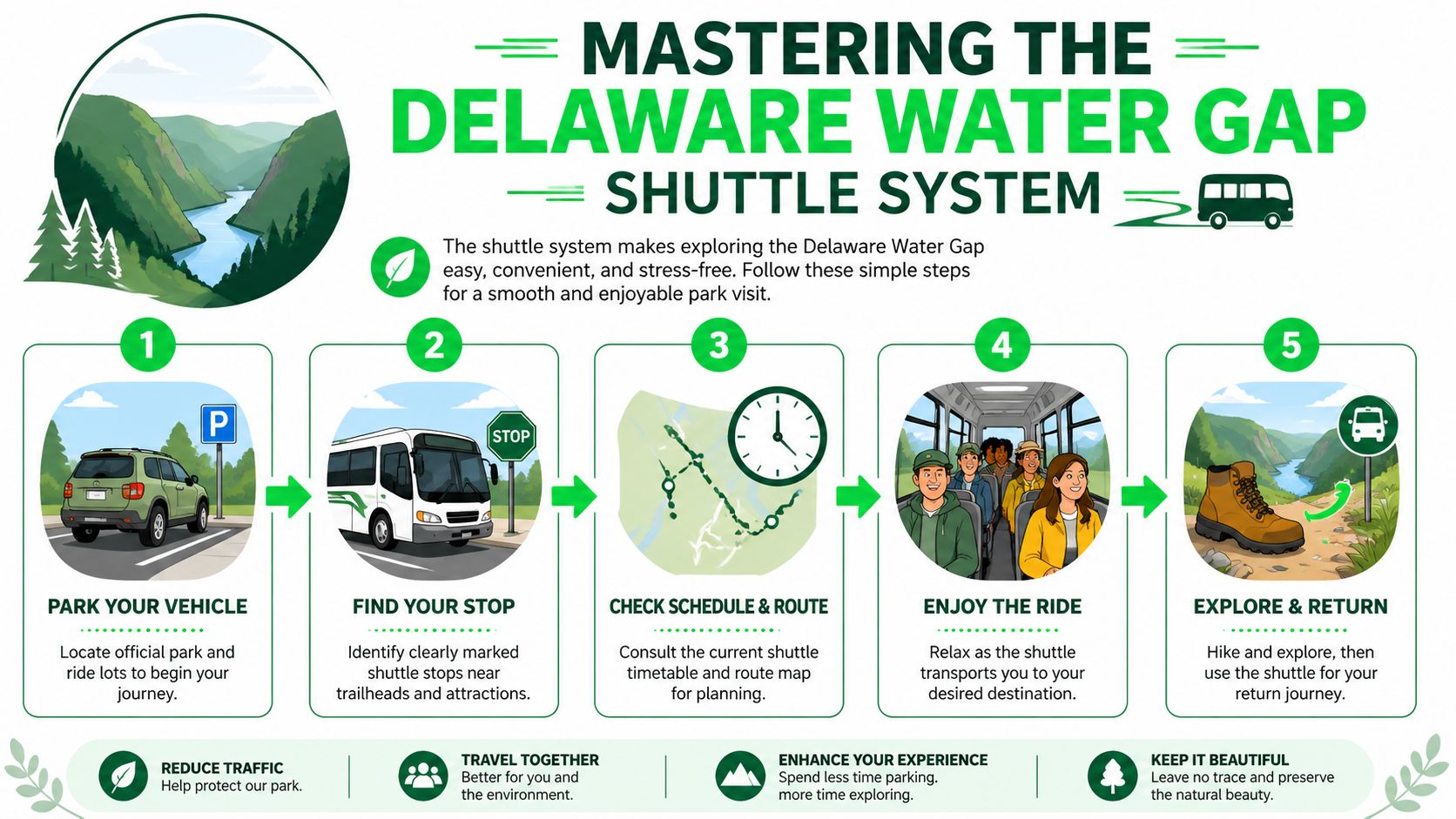
The main service point to understand is the MCTA-operated shuttle system, which was designed to reduce congestion at places like Kittatinny Point. Official park materials note that those high-demand areas often fill by 10 AM on weekends, and the northbound route departs from the park and ride at 8:00, 9:00, and 10:00 AM. Those same materials also note that riders can bring bikes, kayaks, and leashed dogs on the shuttle, which is a major advantage for mixed-use day trips via the official shuttle guide in the 2019 park newspaper.
The shuttle schedule that matters most
For most readers, the northbound morning departures are the decision point. If you miss the early rhythm, the rest of your day gets compressed.
Think of the schedule like this:
8:00 AM departure: Best for hikers who want margin and quieter starts
9:00 AM departure: Fine for lighter itineraries, but less forgiving
10:00 AM departure: Useful only if your plan is short or you’re prioritizing convenience over trail time
If you’re targeting a popular route, earlier is almost always the smarter call. The shuttle works best when it gets you ahead of the crowd, not into it.
How to use it without wasting time
The cleanest process is simple.
Park at the official lot early enough to organize gear without rushing.
Stand at the correct stop before departure, not at departure time.
Carry only what you want to manage on a shuttle.
Know whether your trip is one-way, looped, or out-and-back before boarding.
Missed shuttles create bad decisions. People either shorten the trip too aggressively or improvise a route they didn’t research.
For paddlers, the shuttle is one of the park’s best convenience tools. Instead of doing an awkward vehicle shuffle or adding a long gear carry, you can use the system to get to a put-in while leaving your vehicle in a stable starting location. For hikers, the value is different. It opens point-to-point movement and takes parking pressure off the front end of the day.
If you like planning your movement blocks in advance, a tool for trip planning workflows can help you keep departure times, gear notes, and return timing aligned.
Who benefits most
The shuttle isn’t equally useful for every visitor. It’s strongest for:
Mt. Tammany and nearby hikers trying to beat trailhead parking issues
River users moving boats or gear with less hassle
Bike riders who want transport help without two-car coordination
What doesn’t work well is showing up undecided. The shuttle rewards people who know their route and punishes people who want to “figure it out” after parking. At the Delaware Water Gap, that difference matters.
Pro Tips for a Seamless Trip
The best Delaware Water Gap day trips feel almost boring on the logistics side. That’s a compliment. You park once, move with purpose, and save your attention for the views.
The natural beauty enhances that payoff. The Delaware Water Gap was carved by the Delaware River over roughly 500,000 years through Kittatinny Mountain, and the 40-mile Middle Delaware is protected as a Scenic and Recreational River with Class I-II rapids that suit paddling, as described in the official Guide to the Gap. Knowing that geological scale changes how you experience the place. The overlooks feel more dramatic because the landform is truly dramatic.
Three efficient day plans
The early hiker plan
Use the park-and-ride as your anchor. Catch an early shuttle, start your hike before the main rush, and build in time for a relaxed finish rather than a forced turnaround. This works best if you want strong views without spending the morning searching for a space.
The paddle-first plan
If your main goal is river time, lean into the shuttle’s gear-carry usefulness. Keep your packing modular so you can move from car to shuttle without reworking everything on the spot. Paddlers who pre-sort dry bags, footwear, and post-trip clothes usually move through the day much faster.
The mixed outing
This is the strongest option for a time-conscious visitor. Use the park-and-ride and shuttle for a short scenic hike or viewpoint, then add a calm town stop, river access point, or picnic break on the back half of the day. You don’t need to prove anything out here. You need a trip you’ll actually want to repeat.
The smartest day trip is usually the one that leaves an hour of slack in the schedule.
Pack for transitions, not just the trail
A lot of people pack for one activity. The Gap often rewards packing for transitions.
Bring:
A clean layer for the ride back: Especially useful after paddling or humid hiking.
One compact food option you can eat fast: Parking lots and shuttle stops aren’t where you want to discover you’re starving.
Shoes that can handle mixed surfaces: Your day may include pavement, gravel, shuttle boarding, and trail sections.
What doesn’t work is overpacking. A huge bag slows boarding, clutters your seat area, and makes every transition less efficient.
The local-expert trade-off
There’s always a temptation to squeeze in one more stop. Resist it if it threatens your return timing. The Gap rewards focus. Pick one headline activity and one backup, not five maybes.
That’s especially true if you’re visiting from the city and trying to preserve the calm that made you come in the first place.
Exploring Your Other Transportation Options
The official park-and-ride and shuttle system is the cleanest setup for many visitors, but it isn’t the only one. Sometimes your group size, timing, or comfort level makes another option more practical.
The main alternatives are straightforward: direct trailhead parking, ride-hail or private drop-off, and using the park-and-ride as a carpool meet point without taking the shuttle. Each has a place. None is universally best.
Transportation options at a glance
Method | Typical Cost | Convenience | Flexibility |
|---|---|---|---|
Official park-and-ride and shuttle | Varies by current shuttle arrangement | Strong for planned trips to busy areas | Moderate, depends on shuttle schedule |
Direct trailhead parking | Park fees and local rules vary by location | Highest if you arrive early and get a spot | High until lots fill |
Ride-hail or private drop-off | Varies by demand and distance | Good if you want to avoid parking entirely | Moderate, return pickup can be less predictable |
Carpool via park-and-ride | Shared by your group | Good for reducing vehicles | High if one car handles the day plan |
For busy professionals, the decision usually comes down to one question: do you want control or certainty? Direct trailhead parking offers more control if you arrive early enough. The shuttle offers more certainty when crowding is the bigger risk.
When the alternatives make sense
Choose direct trailhead parking if you’re going very early, visiting on a lower-pressure day, or heading somewhere less dependent on shuttle timing. It works best for people comfortable adapting on the fly.
Choose ride-hail or private drop-off if your group wants to avoid parking complexity altogether. Just be realistic about the return. Rural and recreation-area pickups aren’t always as frictionless as city pickups. The broader transportation challenge is often about navigating the crucial 'first mile/last mile' challenges, and the Gap is a good example of that principle in real life.
Choose carpool-only from the park-and-ride if your main need is a simple, recognizable meeting point. This is useful when one person knows the park well and everyone else wants to follow one vehicle.
If you’re combining the Gap with an overnight or regional stop, keeping lodging and movement notes together through a hotel booking workflow can reduce the usual app-switching mess.
A transport plan isn’t good because it sounds flexible. It’s good because it matches how disciplined your day actually is.
Quick Fixes for Common Parking and Shuttle Problems
Most Delaware Water Gap day trips don’t fail because of the park. They fail because people don’t have a backup plan for small logistics problems.
That’s fixable. If you think through two or three likely issues before you leave, you’ll handle the day with a lot more confidence.
If the lot is fuller than expected
Don’t burn your morning in circles. If your preferred setup isn’t working, make a quick decision.
Use this order:
Switch to a simpler itinerary: Shorten the route and prioritize one destination.
Use the park-and-ride as a regroup point: If you’re with others, consolidate the plan instead of having everyone improvise.
Abandon the “perfect” version of the day: A calm shorter outing beats a chaotic ambitious one.
The bad move is indecision. Ten minutes of hesitation often becomes an hour of poor recovery.
If you miss a shuttle
First, stop trying to salvage the original itinerary exactly as planned. That’s where people compound the mistake.
Instead:
Check whether a later departure still fits your hard return time.
If not, shift to a closer objective or direct access option.
Tell your group the revised plan immediately so nobody is optimizing for the old one.
A clean downgrade keeps the day intact. A stubborn attempt to force the original route usually doesn’t.
If accessibility details are unclear
This is the area where visitors need to be most careful. There is a real information gap.
Official park and shuttle pages often don’t clearly state wheelchair access details, ADA parking specifics, or whether shuttle vehicles are equipped for disabled passengers, according to the National Park Service shuttle information page. That means you shouldn’t assume the delaware water gap park and ride will meet a specific accessibility need unless you’ve confirmed it directly.
The practical move is to verify before travel:
Call ahead for current shuttle vehicle details
Ask specifically about boarding method, storage, and parking accommodation
Build a fallback outing that doesn’t rely on unconfirmed access features
If accessibility information is missing, treat that as an unresolved planning issue, not a minor detail.
That may sound cautious, but it’s the right kind of caution. For families, older visitors, and anyone managing mobility constraints, certainty beats optimism every time.
If you need one last local rule
Keep your trip conservative. Follow posted parking rules, use official transport channels when possible, and don’t improvise around restricted areas or unofficial roadside stops. Most avoidable problems at the Gap start with someone trying to save a few minutes.
If your schedule is packed and you want day trips to run cleanly, Superchat can help keep the moving pieces in one place, from reminders and route notes to bookings, follow-ups, and the return-home logistics that usually get scattered across too many apps.


