
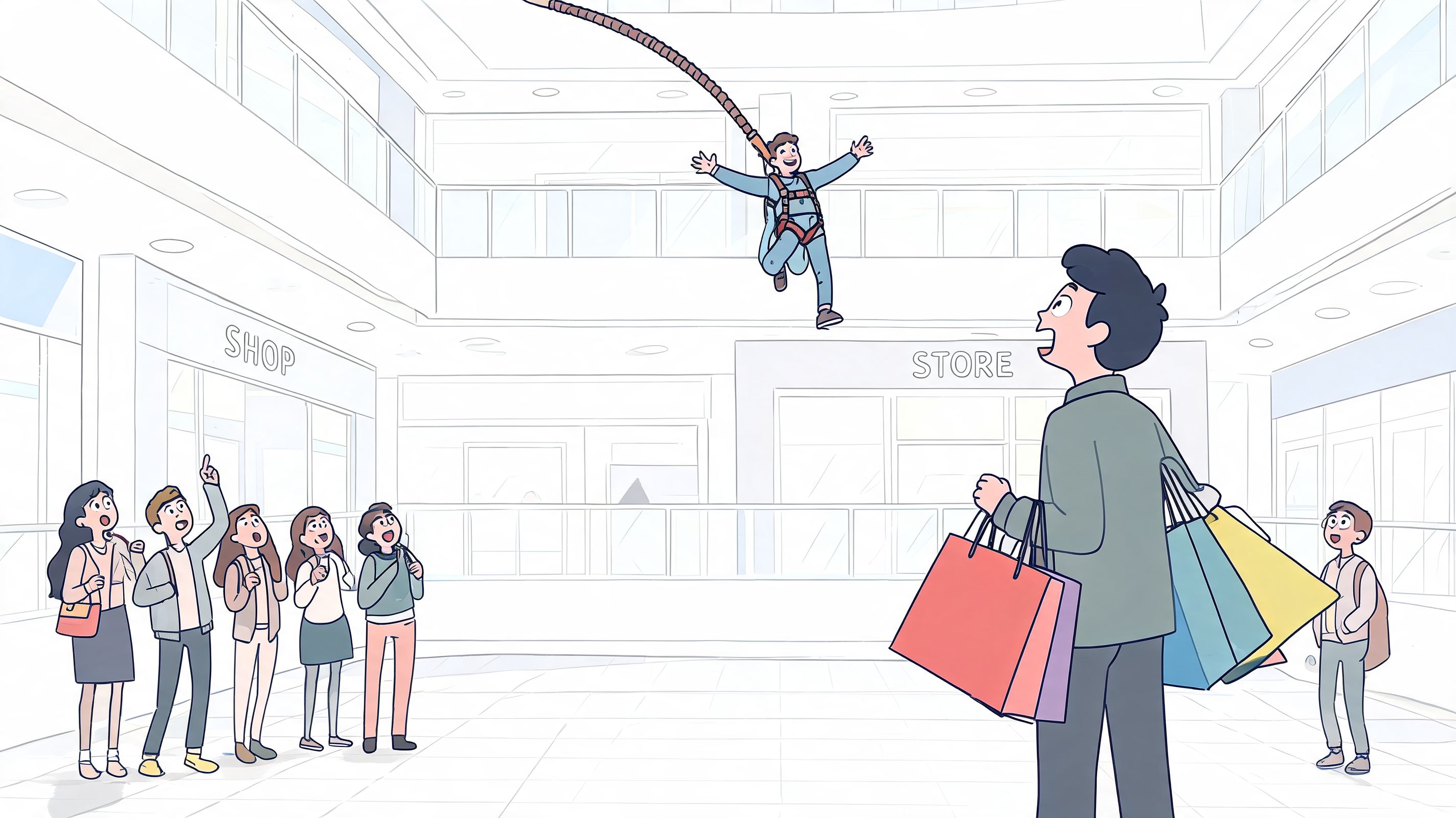
You’re probably doing something ordinary right now. Maybe you’re squeezing in a mall trip between meetings, picking up a gift, returning a shirt, or killing time before dinner. Then you look up and see someone rising into the air on elastic cords in the middle of the mall.
That moment creates two reactions at once. First, curiosity. Second, caution.
If you’ve never seen bungee jumping in the mall, your brain may jump straight to bridge jumps, dramatic drops, and a level of risk you’d never fit into a busy weekday. But mall-based versions are usually designed for short, controlled bursts of excitement that feel more like a structured micro-adventure than an all-day extreme sport outing. They sit close to family areas, food courts, and retail zones because they’re meant to be accessible, visible, and easy to try.
For a busy professional, that matters. You don’t want vague instructions, surprise paperwork, or a long wait after you’ve already parked and committed. You want to know what it is, whether it’s safe, what rules matter, and how to make the whole thing fit into a tight schedule without turning a quick outing into a project. If you already use tools for AI shopping assistance, this kind of mall stop will feel familiar. It’s another case where convenience and planning shape the experience as much as the activity itself.
The good news is that the basics are learnable fast. Once you understand the setup, the logistics, and the safety logic behind the ride, the idea becomes much less mysterious and much more manageable.
Table of Contents
Introduction The Ultimate Shopping Break
A quick thrill in an ordinary place
Why busy adults get interested in it
Understanding Mall Based Bungee Experiences
What you are actually riding
How it feels compared with outdoor bungee jumping
Safety Standards and Operator Certifications
What careful operators do on site
What certifications mean in practice
Planning Your Jump Booking Costs and Rules
How to plan a smooth visit
Why weight and fit rules matter
Simplify Your Adventure with Superchat
Before using one assistant
After using one assistant
Frequently Asked Questions About Mall Bungee Jumping
What should I wear
Is it scary if I do not like heights
Can I eat beforehand and bring my phone
Will I look ridiculous if I am an adult doing it
How long does the whole thing take
Should I do it alone or with someone
What is the smartest first-timer mindset
Introduction The Ultimate Shopping Break
A lot of people first encounter mall bungee attractions by accident. You’re carrying shopping bags, scanning for coffee, and then you hear the bounce of a trampoline bed, the click of harness clips, and the sudden laughter of someone who clearly did not expect to go that high.
That surprise is part of the appeal. A mall is built around errands and routine. A bungee attraction interrupts that rhythm with a short, memorable burst of motion. For people who like novelty but don’t have time to drive to a remote adventure park, that’s a real draw.
A quick thrill in an ordinary place
The strongest example in the verified data is Orange Park Mall in Florida, which features a bungee jump attraction directly in the food court area as part of its play space. It’s described as a family-friendly setup that lets kids and adults jump while safely harnessed, right in a controlled indoor environment at Sears Court, according to this Orange Park Mall play area overview.
That detail matters because it clears up a common misunderstanding. Hearing “bungee jumping” often brings to mind a giant outdoor drop. Mall versions are usually adapted for lower heights, operator control, and padded surroundings. The same Orange Park example notes that indoor variants prioritize safety with lower heights and padded landings, while traditional bungee jumping is associated there with a 1 in 500,000 fatality risk.
Practical rule: If the attraction is in the middle of a food court or family zone, treat it as a controlled entertainment system, not as a bridge-jump simulation.
Why busy adults get interested in it
A busy professional usually doesn’t want “extreme” for its own sake. What sounds better is a short break that changes your mood. A mall bungee session can do that because it’s compact, visible, and usually easy to understand once you watch one or two riders go first.
A few reasons it appeals to adults with packed schedules:
It fits a gap in the day. You can try it between errands instead of blocking out a whole afternoon.
It’s socially easy. One person can ride while others watch, grab coffee, or keep shopping nearby.
It feels fresh without being remote. You get novelty without driving to a dedicated adventure venue.
The learning curve is short. Most first-timers understand the process after a brief operator explanation.
For cautious people, the key shift is mental. Don’t ask, “Would I do a giant outdoor bungee jump?” Ask, “Would I do a short, supervised indoor ride designed for a retail environment?” Those are very different questions.
Understanding Mall Based Bungee Experiences
A mall bungee attraction usually works more like a controlled bounce-and-lift system than a classic outdoor jump. That difference matters, because the phrase bungee jumping in the mall can set the wrong expectation for a first-timer who is picturing a large drop, a cliff edge, or a bridge platform.
What you will usually see is a bungee trampoline setup. You step into a harness, staff attach elastic cords on both sides, and you start from a trampoline bed below. As you jump, the cords stretch and return energy upward, which helps you rise higher than you could on a standard trampoline and come back down in a more predictable pattern.
For a busy professional, that setup is part of the appeal. It is short, visible, and easy to size up before you commit. You can watch one or two riders, see how the fitting process works, check whether the pace feels comfortable, and decide whether it fits into a lunch break, an errand run, or a quick reset between meetings.
What you are actually riding
The system has a few parts, and each one has a clear job.
Part of the system | What it does |
|---|---|
Harness | Secures your body and spreads force across stronger areas like the hips and upper legs |
Bungee cords | Stretch during descent and help lift you back upward |
Trampoline bed | Gives you a jumping surface and softens the return |
Support towers | Keep the cords aligned and limit side-to-side movement |
Operator controls | Help staff set tension, check fit, and start the ride correctly |
A good comparison is a gym cable machine combined with a trampoline. The machine guides the path. The trampoline provides the push. The cords change how high and how smoothly you move.
That is why the ride tends to feel springy, not sudden.
How it feels compared with outdoor bungee jumping
The emotional experience is different too. Outdoor bungee jumping is built around one major moment of commitment. Mall systems usually build height little by little, starting from small jumps and increasing as your confidence grows.
For cautious adults, that gradual start removes a lot of the mystery. You are not stepping into open space. You are learning the motion one bounce at a time, with staff nearby and the full setup in plain view.
Another practical difference is the setting. In a mall, the routine is easy to observe before you participate. You can see how riders are clipped in, how high they go, how they come down, and how they get out of the harness. That kind of visibility helps people make a calmer decision because the process stops feeling unknown.
A short session is also part of the design, not a downside. For someone with a packed schedule, mall bungee works well as a small adventure instead of an all-day outing. You get a quick burst of novelty and movement without the planning load that usually comes with outdoor adventure sports.
If your main concern is, "Can I fit this into a real workday without turning it into a project?" the answer is often yes. The clearer the operator's process is, the easier it becomes to treat the experience as a manageable micro-adventure. That is also why tools like Superchat can help later with the practical side, such as confirming details quickly instead of chasing answers across multiple channels.
Safety Standards and Operator Certifications
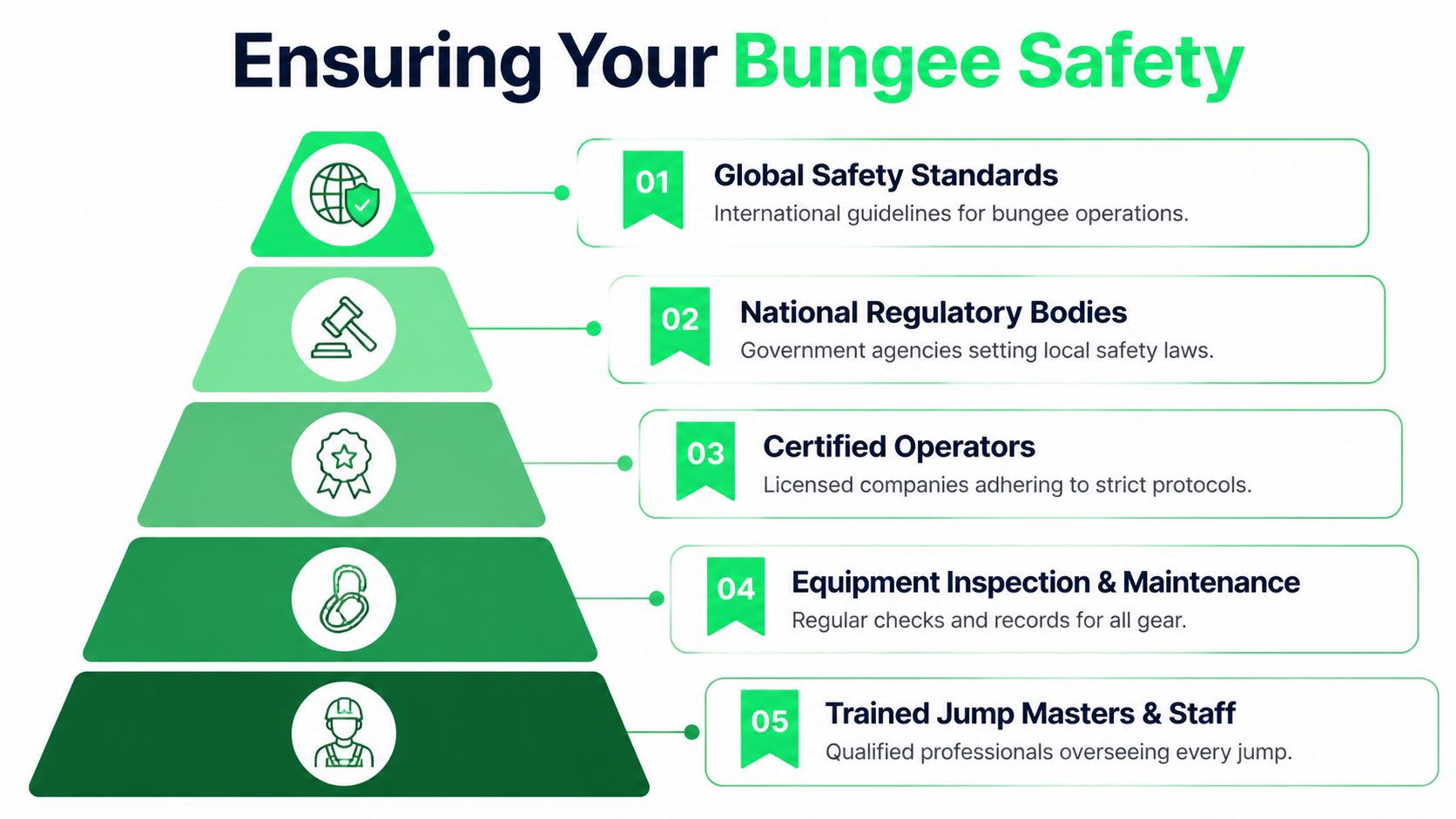
A mall bungee setup should feel closer to a managed piece of equipment than a dare. For a busy professional squeezing in a quick jump between meetings, that distinction matters. You are not betting on chaos. You are relying on a repeatable process, trained staff, and equipment adjusted to the person in the harness.
The force of the jump is one part of that process. As noted earlier, operators on bungee trampoline style systems control how the cords are set for different rider weights, then monitor the bounce so the experience stays within the ride’s intended range. In plain terms, the setup for a lighter rider should not be the setup for a heavier rider. A good operator treats that adjustment the way a fitness trainer treats resistance on a machine. The setting changes with the user.
What careful operators do on site
You do not need technical training to spot whether the operation is being run well. You only need to watch the flow for a minute or two.
Strong operators usually show the same habits:
They ask about weight and fit before the jump starts. That check affects cord setup and harness fit.
They tighten and recheck the harness in a calm, visible routine. Fast is not the goal here. Correct is.
They keep the jump zone controlled. One active rider, clear boundaries, no wandering into the setup area.
They give simple instructions in sequence. First the harness check, then the clip-in, then the jump guidance.
They pause if something looks off. Staff who are comfortable stopping the line are usually taking safety seriously.
A cautious visitor can learn a lot just by observing one cycle from queue to landing. Watch how the staff clip in the rider, communicate during the jump, and bring the rider back down. If every step looks consistent, that is reassuring. If each staff member seems to do it differently, treat that inconsistency as a warning sign.
A useful comparison comes from public event operations. The same habits that reduce risk in crowded venues also matter here. This overview of identifying hazards at football events covers a different environment, but the principle is the same. Clear procedures, active supervision, and controlled movement lower the chance of preventable mistakes.
What certifications mean in practice
Certification language varies by country, mall, and operator. Some venues highlight staff training. Others focus on equipment inspection, operating procedures, or compliance with local amusement rules. The label matters less than the behavior you can verify in front of you.
Look for evidence of a real system:
Eligibility checks happen before anyone is clipped in.
Staff inspect visible straps, clips, and connection points each cycle.
One person is responsible for the active rider instead of multitasking across several tasks.
The team can explain the process clearly when asked.
That last point matters more than it may seem. A trained operator should be able to answer a practical question without sounding annoyed or vague.
Try asking this on arrival: “How do you adjust the setup for rider size, and what checks happen before the jump starts?”
Their answer should be specific, calm, and easy to follow. For someone fitting this into a tight schedule, that quick conversation can save time and remove doubt. It is also the kind of detail Superchat can help you confirm in advance, so your micro-adventure stays simple instead of turning into another planning task.
If the staff rush the briefing, ignore eligibility questions, or treat the harness check like a formality, skip the jump. Walking away is good judgment, not overthinking.
Planning Your Jump Booking Costs and Rules
The actual experience takes shape. Most hesitation around bungee jumping in the mall isn’t about fear alone. It’s about friction. People don’t want to circle parking lots, stand in the wrong queue, or discover a restriction after they’ve already made the effort to show up.
How to plan a smooth visit
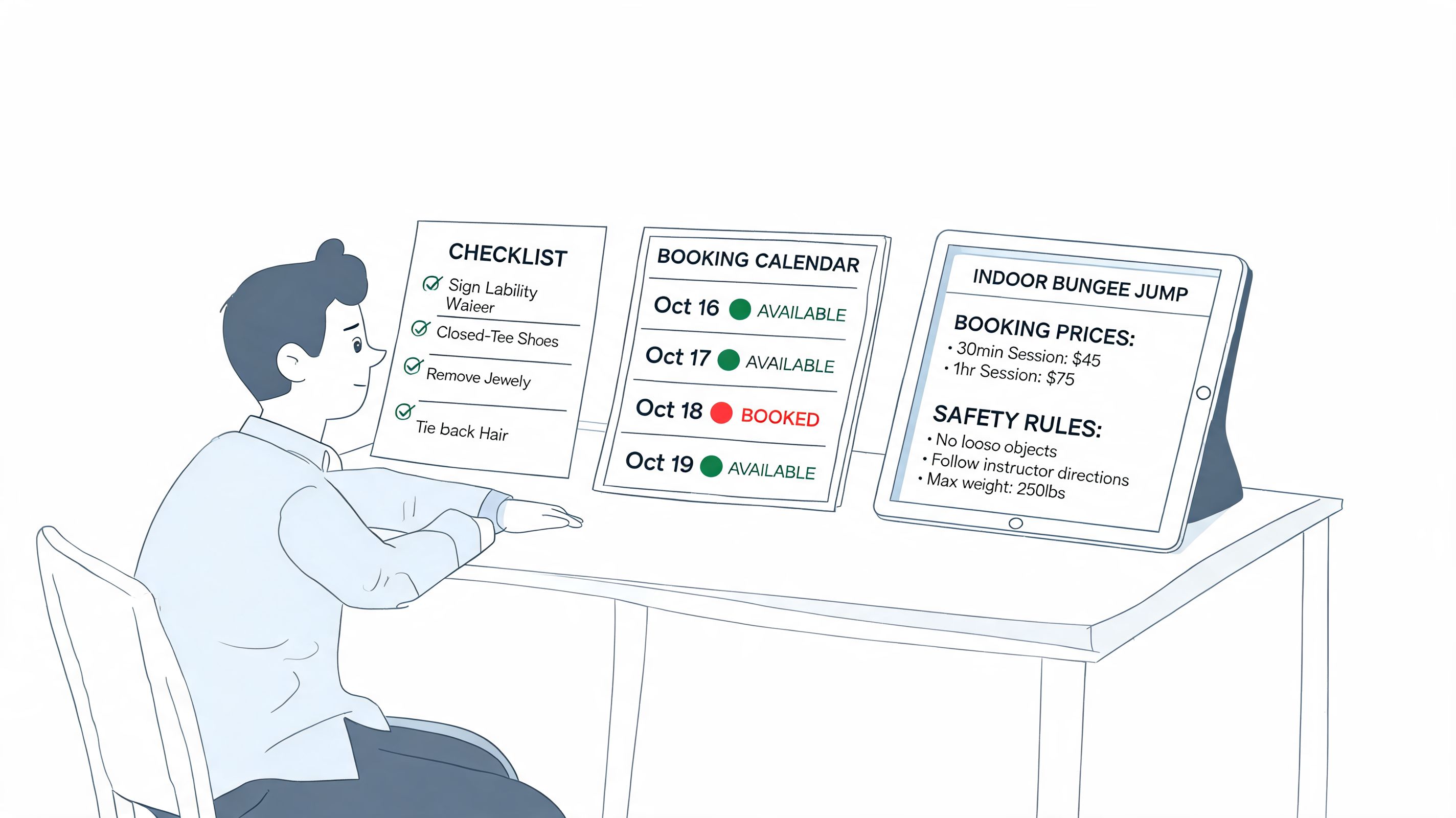
Mall attractions vary a lot in how they handle access. Some are walk-up only. Some operate on first-come, first-served lines. Others may use a venue desk, a family entertainment counter, or a broader mall leisure booking system. Because verified pricing data is not available here, it’s better to assume that cost and booking style will vary by operator and location.
A practical planning sequence looks like this:
Check the attraction’s location inside the mall. Food court and family-zone attractions are easier to find quickly than those tucked into entertainment wings.
Call ahead if your schedule is tight. Ask whether they accept walk-ups, require waivers, or have expected wait times.
Time your visit around peak mall traffic. If you dislike crowds, avoid the busiest shopping windows.
Wear simple, secure clothing. You want the harness to fit cleanly and comfortably.
Build buffer time. Even a short ride can take longer if there’s a queue or a detailed harness check.
If driving logistics are part of the decision, planning parking in advance helps more than people expect. A quick parking solution like car parking support through Superchat fits the same mindset as the activity itself. Keep the outing compact, predictable, and low-friction.
Why weight and fit rules matter
Some riders get annoyed by restrictions because they assume they’re arbitrary. They’re not. In verified data tied to engineered jump setups, operators in Dubai use cords with spring constants around k≈8-12 N/m for riders in the 60-100kg range, and they adjust the number of cords based on rider mass so deceleration forces stay within safe limits, as described in this explanation of mass calibration and cord matching in controlled bungee systems.
That’s the technical reason rules can feel strict. The ride only feels smooth if the system is tuned to the rider. Too much or too little resistance changes the quality of the rebound and the forces on the body.
If staff ask your weight, they’re not being intrusive. They’re doing the setup work that makes the ride function properly.
A few common rules you may encounter:
Rule type | Why it exists |
|---|---|
Weight limits | So the cords and rebound profile match the rider |
Height or harness fit rules | So the harness sits securely on the body |
Age requirements | So the rider can follow instructions and fit the system |
Shoe guidance | To reduce slipping or loose-item problems |
No loose objects | To prevent phones, keys, or accessories from falling |
Before you go, it helps to watch how riders of different sizes are handled. If the operator changes the setup between riders, that’s a good sign. It shows they’re treating the system as adjustable, not one-size-fits-all.
A short look at the motion can also help set expectations:
For busy adults, the best approach is simple. Confirm the basics early, arrive dressed for movement, and leave enough room in your schedule that you don’t feel rushed into saying yes or no.
Simplify Your Adventure with Superchat
For most busy people, the hard part of a micro-adventure isn’t the jump. It’s the admin around it.
You check the mall website. Then you search social posts to see whether the attraction still exists. Then you call the venue. Then you look up parking. Then you message the person you’re meeting. Then you try to fit the stop between two other commitments. The activity takes minutes. The coordination takes far longer.
Before using one assistant
The fragmented version usually looks like this:
map app for directions
browser tabs for mall info
messages to confirm timing
calendar checks
payment app or wallet
notes app to remember rules
That stack of tiny tasks is exactly why many people skip fun things that are nearby and manageable. Not because they don’t want the experience, but because they don’t want the coordination tax.
After using one assistant
A tool like Superchat is a natural fit. Instead of juggling separate apps, you can handle the moving parts in one conversation thread. If you’re planning a broader outing, trip planning with Superchat is the kind of feature that helps turn “maybe later” into “booked and scheduled.”
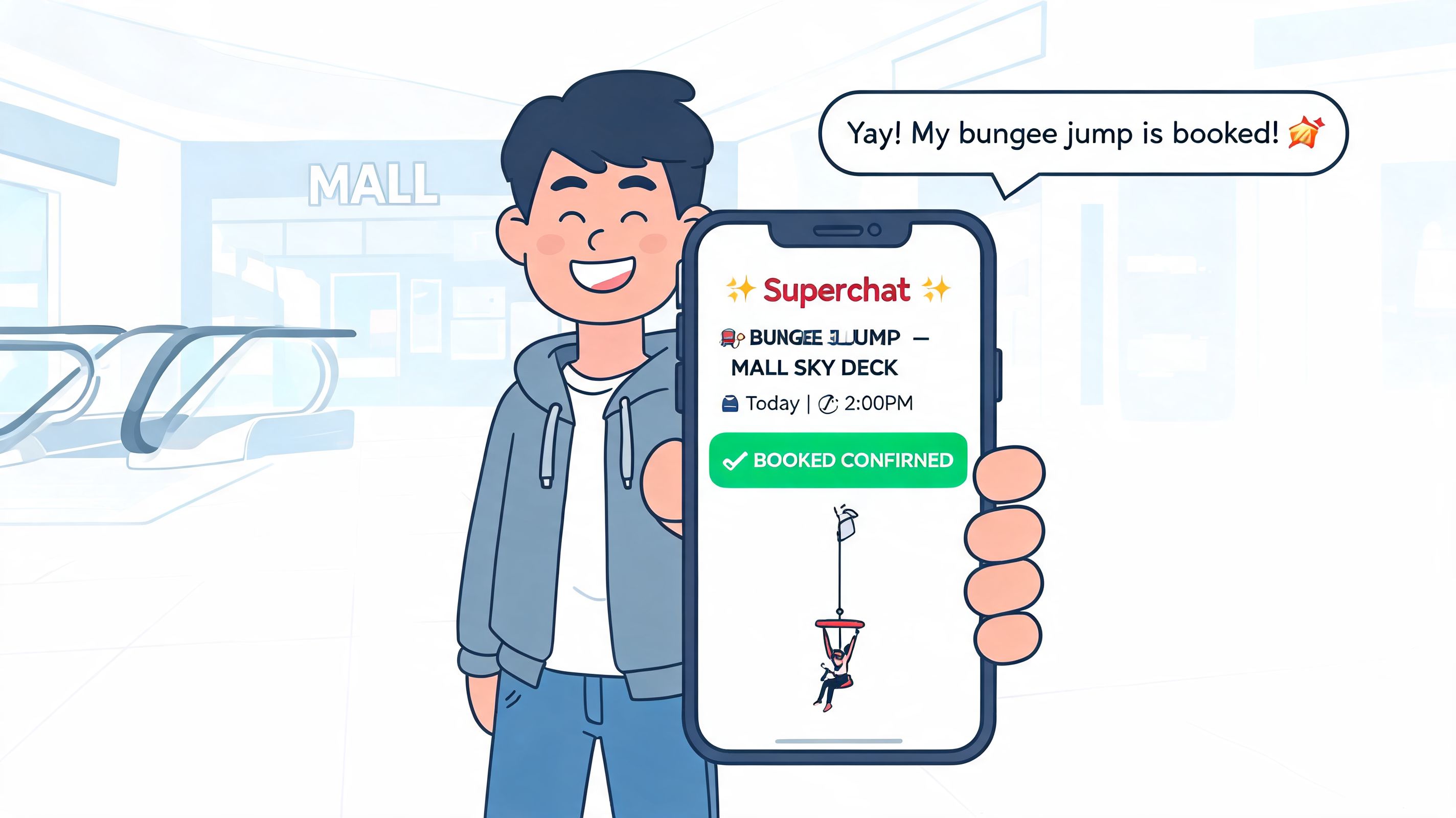
A cleaner workflow might look like this in practice:
Task | Without one assistant | With one assistant |
|---|---|---|
Find the venue | Search manually across sites | Ask in chat |
Check timing | Call or browse multiple pages | Keep it in one thread |
Coordinate with someone | Switch to messaging apps | Send and track from the same place |
Set reminders | Enter calendar details yourself | Add scheduling in the same flow |
Handle payments | Move across apps | Keep actions connected |
“Micro-adventures work best when the planning feels lighter than the experience.”
That’s the key productivity angle here. A mall bungee session should stay small. It should feel like a smart detour, not a mini operations project. If you’re the kind of person who already optimizes travel, errands, and booking tasks, centralizing those steps makes the outing much more likely to happen.
The value isn’t only speed. It’s mental clarity. When one place holds the plan, timing, and follow-up, you’re freer to decide whether you want the experience. That’s better than being worn down by logistics before the fun even starts.
Frequently Asked Questions About Mall Bungee Jumping
First-timers usually don’t have one big concern. They have six small ones. That’s normal. Most of these are easy to handle once you know what to expect.
What should I wear
Wear clothes you can move in comfortably. A fitted T-shirt, athletic top, or light casual shirt works well. Avoid anything too loose, too slippery, or awkward under a harness.
Shoes should stay securely on your feet. If you’re unsure, ask the operator before joining the line. Leave dangling accessories, large bags, and loose items with a companion or in a safe spot.
Is it scary if I do not like heights
It can still feel intimidating, but many people who dislike heights find this more approachable than they expected. The reason is that the motion usually builds from bouncing rather than from stepping off a high ledge.
If you’re nervous, watch several riders first. Notice the harnessing, the operator cues, and the landing rhythm. Then decide whether your curiosity is stronger than your hesitation. You don’t need to prove anything. A short, modest first try is enough.
Can I eat beforehand and bring my phone
A light meal is usually more comfortable than a heavy one. You don’t want to feel overly full while bouncing and rotating. Hydration helps, but keep it reasonable.
As for phones, many attractions won’t want unsecured personal items on the rider. Even if they allow it, think carefully. A dropped phone in a busy public area creates problems for you and for people below. It’s usually better to have someone else record.
Will I look ridiculous if I am an adult doing it
Probably less than you think. Mall bungee attractions sit in public view by design. Plenty of adults hesitate because they feel exposed, not because they fear the motion itself.
The easiest fix is to own the moment. You’re doing something playful in the middle of an ordinary day. That’s allowed. Most onlookers are interested, not judgmental.
Adults usually regret overthinking it more than they regret taking one supervised ride.
How long does the whole thing take
The ride itself is short. The total visit depends on queue length, harness fitting, and whether the operator is moving riders through carefully. If your day is tightly scheduled, plan for waiting rather than assuming instant access.
That’s the difference between a pleasant micro-adventure and a frustrating one. The more buffer you leave, the more relaxed the experience feels.
Should I do it alone or with someone
Either can work. Going alone is efficient if you’re nearby and spontaneous. Going with someone makes the wait easier and gives you an audience, photographer, and reality check if you’re nervous.
If you’re on the fence, bringing one friend is often the best option. One person can watch the process, hold your things, and go after you if you both decide it looks fun.
What is the smartest first-timer mindset
Treat it like a short, supervised experience that deserves the same attention you’d give any public activity involving gear and staff instructions. Listen closely. Ask direct questions. Don’t force yourself if the setup feels sloppy.
If the operator is calm, the equipment looks well managed, and the rules make sense, you can usually relax and enjoy the novelty of it.
If your days are already packed, the best adventures are the ones that don’t create more admin. Superchat helps you keep bookings, planning, reminders, and payments in one place, so a spontaneous mall stop can stay simple instead of turning into another task chain.


