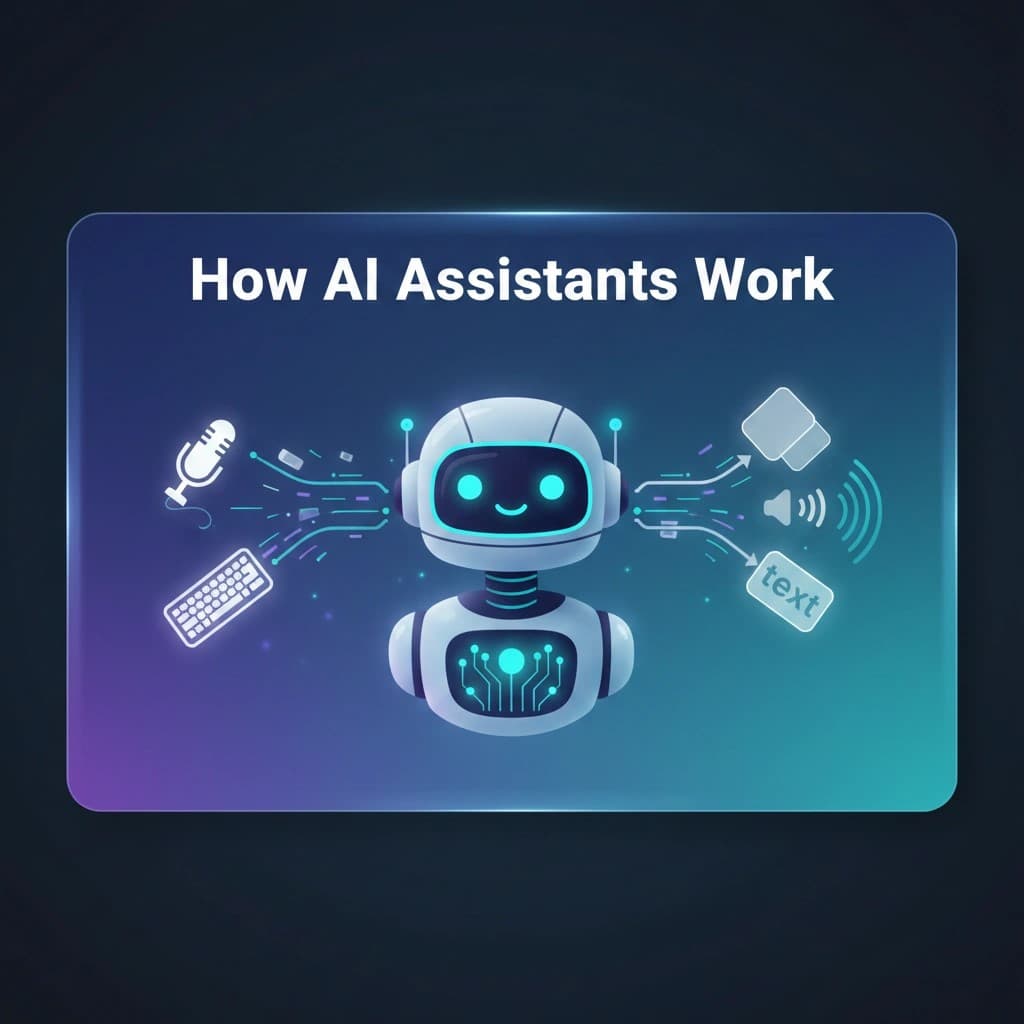
How AI Assistants Work: Technology Explained Simply
An AI virtual assistant is a software system that uses Natural Language Processing (NLP) to understand user intent and Large Action Models (LAMs) to execute multi-step tasks. Unlike simple chatbots that only provide text-based answers, modern AI assistants possess "agency" the ability to interact with external applications via APIs to book appointments, manage finances, or coordinate complex workflows.
By 2026, the technology has shifted from information retrieval to autonomous execution. These systems function through a continuous feedback loop: they perceive input (voice, text, or vision), reason through a logical sequence of actions, execute those actions across connected platforms, and use Machine Learning to refine their performance for future requests.
The Anatomy of Intelligence: Defining the AI Assistant
Beyond Chatbots: Understanding Intent and Agency
What is the difference between a chatbot and an AI virtual assistant? A chatbot retrieves information; an AI assistant executes intent. While a chatbot uses a database to answer "What is the weather?", an AI assistant uses "agency" to interact with software. Agency allows the system to identify a problem such as a flight delay access your calendar via API, and autonomously propose a rescheduled meeting time.
The 7 Stages of the AI Action Cycle
How does an AI assistant process a single command? Every request follows a 7-stage "Action Cycle" to ensure accuracy:
Perception: Capturing voice, text, or visual input.
Linguistic Analysis: Using NLP to break down syntax and grammar.
Intent Recognition: Determining the specific goal (e.g., "ordering food" vs. "searching for recipes").
Context Retrieval: Checking "memory" for user preferences or location.
Logic Reasoning: Mapping the necessary steps to complete the task using a Large Action Model.
Execution: Triggering the action in a third-party app.
Learning: Storing the outcome to improve future success rates.
Personal vs. Business AI: Different Goals, Same Engine
How does an AI personal assistant for business differ from a consumer version? The difference lies in Vector Density and security. Personal assistants optimize for individual lifestyle tasks (smart homes, fitness). A business AI assistant is designed for high-information density; it interacts with enterprise datasets (ERPs, CRMs) and adheres to strict corporate governance, focusing on workflow automation rather than general entertainment.
Input and Interpretation: How the AI "Hears" You
How does an AI assistant interpret human communication? AI assistants use Natural Language Processing (NLP) to convert unstructured human data such as speech, text, or images into structured machine-readable code. This process involves identifying "intent" (what the user wants) and "entities" (the specific details of the request). By utilizing Vector Databases, the system retains a "memory" of past interactions, ensuring that the interpretation of a command is filtered through the user’s specific history and current environment.
Natural Language Processing (NLP): Cracking the Human Code
NLP acts as the linguistic translator for an artificial intelligence assistant. It employs Tokenization to break sentences into smaller units and Semantic Analysis to understand the meaning behind words. This enables the system to resolve ambiguity; for example, distinguishing between "Schedule a call" (a calendar event) and "Make a call" (a telephony action) by analyzing the grammatical context and surrounding keywords.
Context Management: Why Your Assistant Remembers Yesterday
Context is managed via a "sliding window" of recent memory and long-term storage in Vector Databases. When you ask "What about my flight?", the assistant doesn't just search for the word "flight." It retrieves the specific flight details you mentioned in a previous conversation. This persistence of data allows for a continuous, personalized experience where the AI understands pronouns (like "it" or "that") based on prior topics.
Multi-Modal Inputs: Processing Voice, Text, and Vision
In 2026, ai virtual assistants are no longer limited to text. Multi-modal processing allows the AI to analyze different data types simultaneously. The system can "see" a screenshot of a spreadsheet through computer vision, "hear" the urgency in your voice through acoustic analysis, and "read" your text instructions. This combined data stream provides the AI with a higher signal-to-noise ratio, leading to more accurate task execution.
The Brain: Processing and Problem Solving
How does an artificial intelligence assistant solve complex problems? The cognitive core of an ai virtual assistant functions through the interaction of Machine Learning (ML) and Large Action Models (LAMs). While traditional software operates on static rules, an artificial intelligence personal assistant uses neural networks to determine the most efficient path toward a goal. It analyzes your request by dividing it into logical sub-tasks and uses real-time feedback to adjust its reasoning. This architecture is what allows an ai personal assistant for business to handle dynamic workflows rather than just static queries.
Machine Learning: How Assistants Improve Without Being Programmed
Machine Learning is the process that allows an ai voice assistant to refine its performance through data exposure. Every interaction provides a signal that the system uses to update its internal weights. This continuous evolution means your artificial intelligence assistant becomes more adept at recognizing your unique voice patterns and professional preferences. To understand how these improvements translate into daily efficiency, you can explore how an AI personal assistant boosts productivity.
Large Action Models (LAMs): The Logic Behind the Execution
Large Action Models represent the transition from talking to doing. While common models focus on text, a LAM is trained to understand the structure of user interfaces. This allows an ai personal assistant for business to navigate through apps like LinkedIn or SAP just as a human would. Understanding this distinction is key to recognizing why the technology has moved far beyond basic bots; for a deeper dive, read about the differences in AI chatbot vs AI assistant capabilities.
Predictive Analytics: Anticipating Your Needs Before You Ask
Predictive analytics enables an ai virtual assistant to move from reactive to proactive. By identifying patterns in your historical data, the system can forecast your next requirement. If you routinely schedule a follow-up after a specific weekly meeting, the artificial intelligence personal assistant will suggest the calendar invite before you type a single word. This level of anticipation is a primary factor when looking to choose the best AI assistant app in UAE for professional use.
The Hands: Connecting to the Real World
How does an ai virtual assistant interact with other software?
An artificial intelligence assistant interacts with the digital world through Application Programming Interfaces (APIs). These act as secure bridges that allow the assistant to send instructions to external services like banking apps, travel portals, or project management tools. Instead of just talking about a task, the ai personal assistant for business executes the task by transmitting structured data directly into the code of another application.
API Integration: How AI Talks to Your Other Apps
API integration is the mechanism that provides an ai voice assistant with functional utility. When you issue a command to "Send the monthly brief to the team," the assistant uses an API to log into your communication software, attach the correct file, and hit send. This seamless connection ensures that the ai virtual assistant can operate across multiple platforms without the user needing to switch between different apps.
Feature | Traditional AI Assistant | Agentic AI (2026) |
Primary Interaction | Conversational (Text/Voice) | Action-Oriented (Execution) |
System Integration | Surface-level (Reads data) | Deep (Writes to databases/APIs) |
Autonomy Level | Low (Needs human clicks) | High (Multi-step navigation) |
Execution Tool | LLM (Language) | LAM (Large Action Model) |
Executing Transactions: The Technology of Secure Payments
The artificial intelligence personal assistant handles financial transactions through Tokenization. This technology replaces sensitive credit card numbers with a unique digital token. When the assistant pays for a service or a product, it never shares your actual financial data. This ensures that every transaction is secure and specific to that single purchase, maintaining a high level of security for the user. To understand the security protocols involved in these autonomous purchases, you can read more about how AI in payments works to protect your financial footprint.
Autonomous Coordination: From Booking Flights to Scheduling Repairs
Autonomous coordination occurs when your ai virtual assistant communicates with other automated systems. If you need to book a flight, your assistant contacts the airline's server to check availability and prices. It then coordinates with your calendar to find the best time. This AI to AI communication removes the need for human back and forth, allowing the assistant to finalize complex logistics independently.
Safety by Design: Privacy in the Age of Assistants
How does an ai virtual assistant protect user data?
Regional Compliance: Every ai virtual assistant must adhere to local data protection laws, such as UAE Decree Law No. 45.
Sovereign Processing: An ai personal assistant for business ensures sensitive corporate intelligence is processed on local servers rather than international clouds.
Privacy by Design: This architecture minimizes data exposure by anonymizing user inputs before they reach the core artificial intelligence assistant engine.
Security Layers of AI Assistants
Security Tier | Technology Used | Purpose |
Data Privacy | Local Residency | Keeps data on regional servers. |
Authentication | Biometrics | Requires human signature for actions. |
Integrity | Encryption | Protects data in transit and at rest. |
Accountability | Human-in-the-Loop | User approves all critical tasks. |
Local Data Residency and Encryption
Server Localization: To maintain high security, the ai voice assistant stores data within regional borders.
End-to-End Encryption: All communication between the user and the artificial intelligence personal assistant is encrypted, preventing unauthorized interception.
Biometric Gates: High-value actions—like accessing medical records—require a FaceID or fingerprint check. This ensures the ai virtual assistant remains under your direct physical control.
The Human-in-the-Loop (HITL) Requirement
Final Approver Role: The artificial intelligence assistant acts as a co-pilot, not a pilot. It drafts, but you decide.
Action Pauses: For legal or financial tasks, the ai personal assistant for business is programmed to pause for a manual "Final Approval."
Transparency: Every autonomous step taken by the artificial intelligence personal assistant is logged, providing a clear audit trail for the user.
Summary: The Shift from Information to Execution
What is the future of AI assistants?
From Queries to Actions: The primary evolution of the ai virtual assistant is the move from providing answers to completing transactions.
Agentic Intelligence: By utilizing Large Action Models, the artificial intelligence assistant has gained the ability to navigate digital interfaces independently.
Business Integration: The ai personal assistant for business has become a core productivity tool by automating the "busy work" of cross platform data entry and coordination.
Security First: Modern systems, including the ai voice assistant, prioritize local data residency and human oversight to ensure that autonomous execution never compromises user safety.
Personalized Growth: Through continuous Machine Learning, every artificial intelligence personal assistant evolves into a specialized partner that understands specific user workflows and goals.


