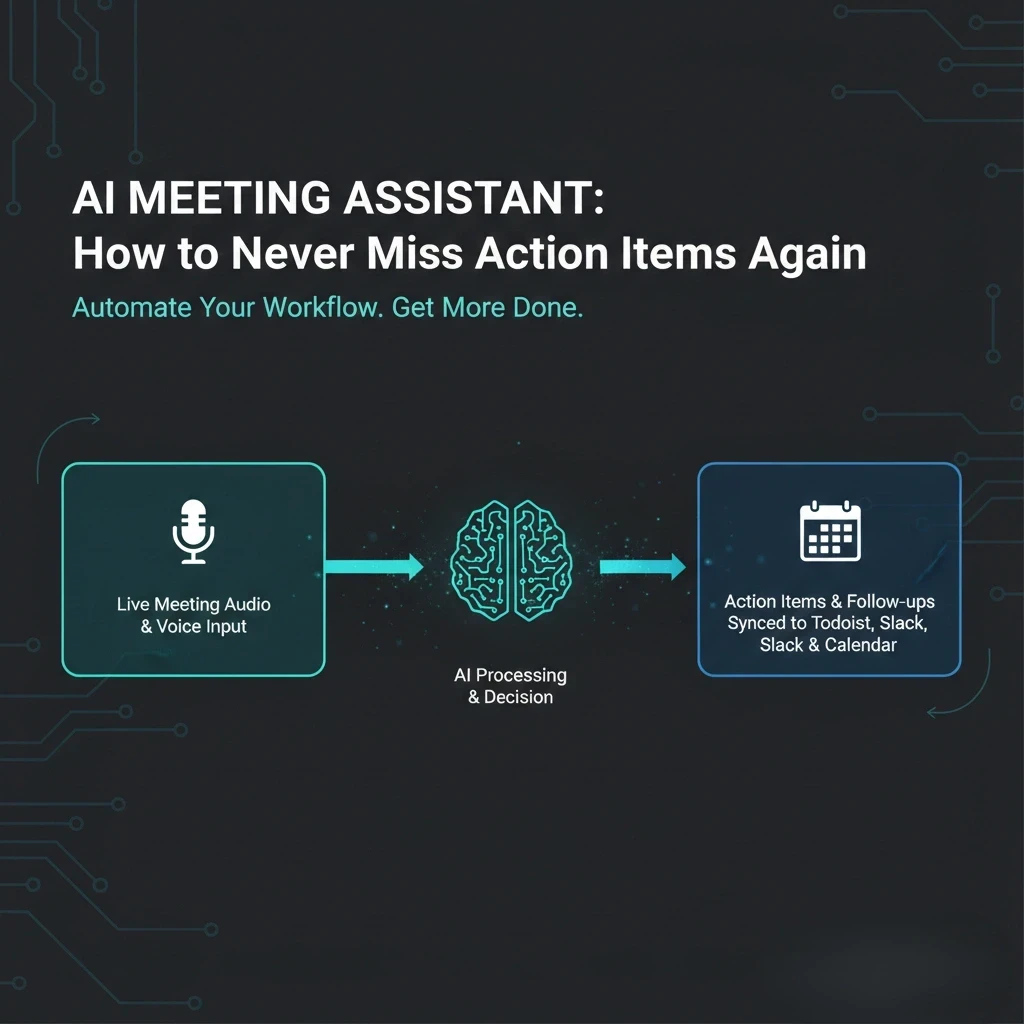
An ai meeting assistant is a specialized software tool designed to transform spoken dialogue into structured, actionable data. Unlike standard recording devices, a best ai meeting assistant uses Natural Language Understanding (NLU) to extract intent, identifying exactly who is responsible for specific tasks. By 2026, these tools have moved beyond simple transcription to become agentic partners that integrate directly into your productivity stack, ensuring that no decision or deadline is lost in the digital noise.
The primary function of a meeting ai assistant is to bridge the gap between conversation and execution. It achieves this by performing real-time speaker identification and automated summarization. By synchronizing with tools like Slack, Notion, or your CRM, an ai assistant for meetings automates the follow-up process, turning a one-hour discussion into a prioritized list of action items. This technology eliminates the need for manual note-taking, allowing team members to remain fully present during critical discussions.
Beyond Transcription: Why Recording Meetings Isn’t Enough
Why is a transcript alone insufficient for modern teams? A transcript is a raw record, whereas an ai meeting notes app provides an analyzed outcome. While a text record captures every word, it lacks the context and hierarchy needed to drive a project forward.
Without intelligent filtering, users are forced to reread thousands of words to find a single assigned task. An ai meeting notes tool solves this by layering "Intent Recognition" over the text, highlighting what actually matters for the project's next steps.
The Digital Clutter Problem: Why Transcripts Fail
Transcripts often create "Information Overload" rather than clarity. A typical one-hour meeting generates approximately 8,000 to 10,000 words. Without an ai meeting assistant, these words become "dark data" unsearchable and unused.
Relying on raw text leads to "Meeting Fatigue," where the time spent reviewing notes rivals the time spent in the meeting itself. This is a primary reason why professionals are moving toward specialized meeting assistant ai solutions that offer distilled insights over verbatim text.
Automated vs. Intelligent Summarization
Automated Summarization: Uses basic algorithms to pick out frequent keywords or phrases.
Intelligent Summarization: Uses Large Language Models (LLMs) to understand the meaning of a discussion.
A meeting ai assistant with intelligent summarization can distinguish between a brainstorming session and a final decision. It identifies the "why" behind a choice, providing a narrative summary that is more useful for stakeholders who missed the call. To understand this difference, you can explore how an AI chatbot vs AI assistant operates in various contexts.
Real-Time vs. Post-Meeting Processing
An ai assistant for meetings can operate in two distinct modes. Real-time processing provides live captions and "instant bookmarks," which are vital for inclusivity and remote participants. Post-meeting processing allows the ai meeting notes tool to perform a deeper analysis of the entire conversation, cross-referencing points made at the beginning of the call with conclusions reached at the end. This dual-layered approach ensures that the final ai meeting notes app output is both immediate and comprehensive.
The Core Tech: How Assistants Capture Accountability
How does a meeting assistant ai identify specific action items? The core functionality of a meeting ai assistant relies on a technology stack that separates vocal frequencies, converts them to text, and applies semantic logic to extract duties. Instead of just recording audio, an ai assistant for meetings uses "entity extraction" to pinpoint names, dates, and deliverables. This ensures that when someone says, "I will send the report by Friday," the software recognizes the speaker, the task (report), and the deadline (Friday).
Multi-Speaker Identification and Voice Fingerprinting
To maintain an accurate record, the best ai meeting assistant uses Diarization. This process identifies different voices and assigns them a "fingerprint."
Voice Separation: The AI isolates overlapping voices to ensure clear transcription.
Speaker Labeling: It matches voice profiles to specific attendees, even in crowded rooms.
Accuracy: This technology allows the ai meeting notes tool to provide a play-by-play account of who committed to what, removing ambiguity about ownership.
Natural Language Understanding for Task Extraction
Natural Language Understanding (NLU) allows the ai meeting notes app to understand the "mood" and "intent" of a sentence.
Intent Recognition: The AI distinguishes between a "suggestion" and a "decision."
Dependency Mapping: It identifies how one task relates to another mentioned earlier in the call.
Contextual Awareness: The system understands that "it" refers to the "marketing budget" discussed ten minutes ago, ensuring high-quality ai meeting notes. This specialized processing is a key part of how ai assistants work to handle complex professional requests.
Integration with Your Productivity Stack
A meeting ai assistant is only effective if its output reaches the tools you use.
Direct Sync: The assistant pushes action items directly into Trello, Asana, or Jira.
CRM Updates: Client meeting summaries are automatically logged into Salesforce or HubSpot.
Automated Briefings: It sends the final notes to participants via Slack or email immediately after the call. This seamless integration is vital for those looking to choose the best AI assistant app in UAE, where cross-platform efficiency is a high priority.
Implementing Meeting AI in the Professional Workspace
How do you successfully integrate an ai meeting assistant into a team? Effective implementation requires balancing technological adoption with legal and ethical standards. To ensure a meeting ai assistant provides value without creating liability, organizations must establish clear protocols for consent, data residency, and usage. This prevents "Shadow AI" unauthorized tool usage and ensures that the best ai meeting assistant remains a secure, company-wide asset rather than a privacy risk.
The Ethics of Recording: Compliance and Privacy
Consent Protocols: Always notify participants before an ai assistant for meetings begins recording.
Data Protection: Ensure the ai meeting notes app complies with regional laws like the UAE PDPL or GDPR.
Access Control: Restrict transcript access to relevant stakeholders to maintain confidentiality.
Training Your Teams for Collaborative Intelligence
Prompt Engineering: Teach teams how to talk to AI effectively to ensure the assistant captures the correct context.
Action-Oriented Language: Encourage speakers to state deadlines and names clearly to improve the ai meeting notes tool extraction accuracy.
Workflow Alignment: Map out how the assistant's output flows into existing project management software.
Managing "Shadow AI" in Corporate Environments
Centralized Vetting: Only use an ai meeting assistant that has passed corporate security audits.
Policy Documentation: Define clearly when and where a meeting assistant ai is permitted, especially during sensitive HR or legal discussions.
Auditing: Regularly review the data stored by the meeting ai assistant to ensure it aligns with corporate retention policies.
Summary: From Capturing Words to Driving Results
How does an AI meeting assistant change organizational outcomes?
Reduced Cognitive Load: By offloading note-taking to an ai meeting notes tool, participants focus entirely on the discussion rather than manual documentation.
Elimination of "Action Item Decay": Automated task extraction ensures that verbal commitments are instantly converted into digital tickets in your productivity stack.
Enhanced Accountability: With multi-speaker identification, there is no ambiguity regarding who owns a task or when it is due.
Unified Intelligence: The best ai meeting assistant connects meeting data with broader business goals, allowing for "Intelligent Recall" of past decisions.
Scalable Efficiency: Teams using a meeting ai assistant reclaim hours of administrative time, directly improving overall project velocity and team morale.


