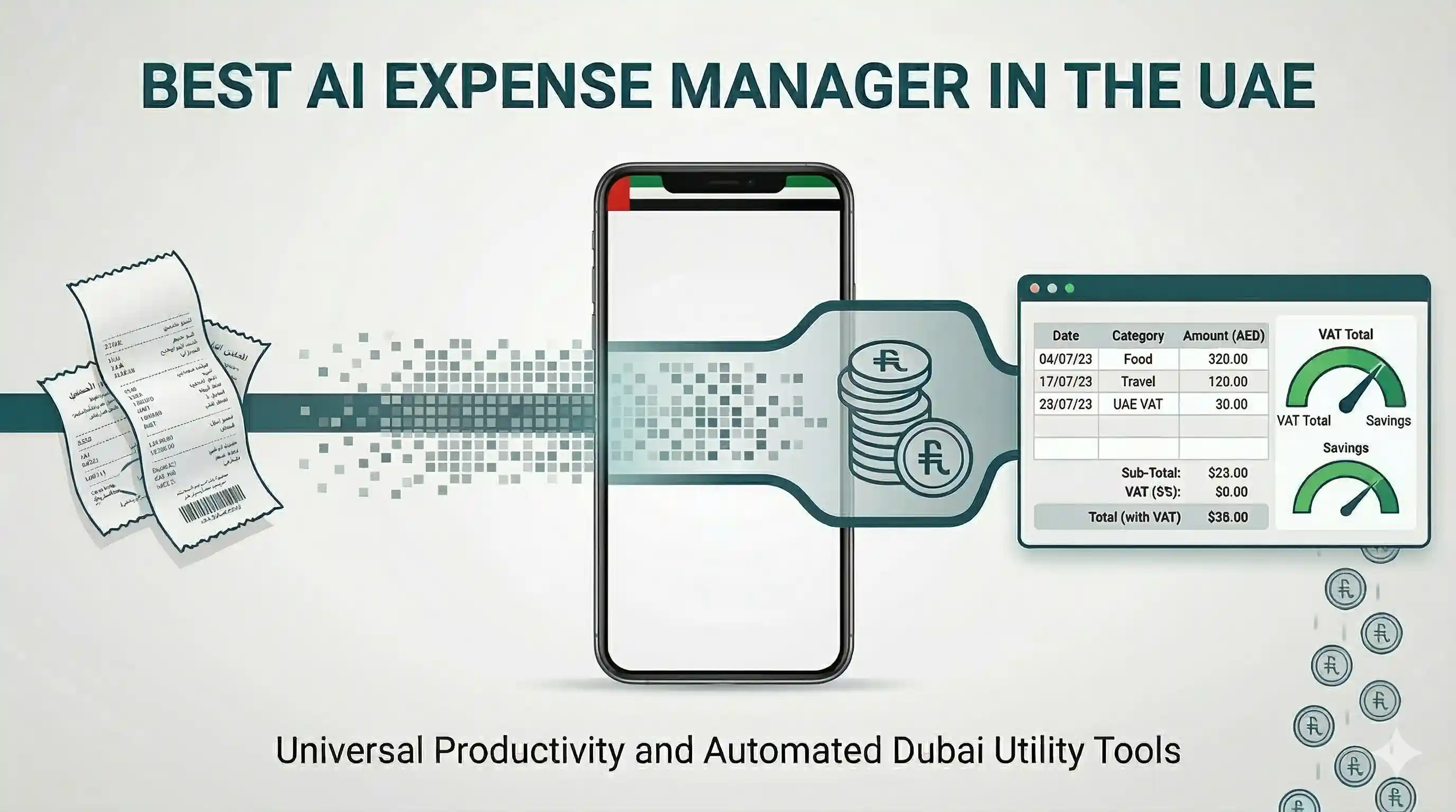
Manual expense tracking means downloading bank statements, categorizing transactions in spreadsheets, and reconciling bills across DEWA, Salik, Etisalat, credit cards, and cash purchases. AI expense management eliminates this entirely: bills are paid automatically, transactions are categorized in real-time, and spending insights appear without manual data entry.
Superchat AI for UAE residents operates as a personal expense manager that automates bill payments, tracks spending across local service providers, and delivers financial insights through chat distinct from business expense tools like Pemo and Alaan which focus on corporate card management rather than personal household finances.
1. Beyond Manual Tracking: Choosing a Private AI Expense Manager
Manual expense tracking consumes 2-3 hours monthly for UAE residents managing utility bills, Salik tolls, mobile plans, groceries, dining, and transport. AI expense managers reduce this to zero by automating payment execution, transaction categorization, and spend analysis.
Can AI Do My Expenses?
Yes. AI expense managers execute three core functions: automatic bill payment (DEWA, Salik, Etisalat processed on due dates without manual login), real-time transaction categorization (dining, transport, utilities sorted automatically), and predictive budgeting (alerting when spending exceeds historical patterns).
Traditional expense apps require manual receipt uploads, category assignment, and reconciliation. AI expense managers extract data from bank feeds, match transactions to merchants, and categorize automatically. For recurring bills, the AI predicts amounts before statements arrive and flags anomalies like unusually high DEWA consumption.
The execution gap: manual apps track what you already spent. AI managers prevent overspending by processing bills autonomously and alerting to budget breaches in real-time. Understanding how AI for time management applies to personal finances clarifies why automation delivers higher ROI than tracking alone.
Why Traditional Banking Apps Fail at Automated Spend Management in the UAE
UAE banking apps (Emirates NBD, ADCB, Mashreq, FAB) display transaction history and account balances. They do not automate bill payments, categorize spending intelligently, or provide actionable budget insights without manual configuration.
The failure points: banking apps show that you spent AED 427 at "DEWA" but do not predict next month's bill, flag consumption increases, or pay the bill automatically. They display Salik deductions but do not top up your account when balance drops below AED 50. They record Etisalat charges but do not compare your current plan against better alternatives.
AI expense managers fill these gaps by connecting payment execution (auto-pay bills), predictive analysis (forecast spending), and optimization recommendations (suggest cheaper service plans). For personal AI agents in UAE managing household finances, passive transaction displays are insufficient active financial management requires execution authority.
Identifying the Gap Between Business Pemo/Alaan Tools and Personal Agents
Pemo and Alaan are corporate expense management platforms designed for businesses managing employee cards, vendor payments, and reimbursement workflows. They track company spending, enforce corporate policies, and integrate with accounting software like QuickBooks and Xero.
Personal AI expense managers operate in your individual financial ecosystem: your personal bank account, your DEWA bill, your Salik account, your family dining budget. Business tools cannot access personal banking, do not integrate with household utilities, and lack features for personal budget optimization.
The architectural distinction: Pemo and Alaan require corporate authentication and operate within business accounting frameworks. Personal expense managers connect to individual bank accounts and UAE household service providers (DEWA, Salik, Etisalat) that business tools have no integration with.
For UAE residents, this means corporate expense tools handle work spending while personal finances remain manual. An AI financial agent in UAE for individual use requires completely different integrations than corporate expense platforms provide.
2. Core Features: What a True AI Expense Manager UAE App Can Do
An AI expense manager UAE app executes payments, categorizes transactions automatically, and delivers spending insights without manual data entry. The shift from tracking to execution is what separates functional financial management from passive record-keeping.
Universal Task Execution: Moving From Notifications to Completed Bill Payments
Notification-based apps remind you when bills are due. Execution-based AI managers pay the bills and confirm completion. The difference eliminates recurring monthly tasks entirely.
For DEWA bills, execution means the AI monitors your account, retrieves the bill when issued, processes payment on the due date through your authorized bank account, and delivers confirmation with transaction reference. You receive "DEWA bill paid: AED 523, ref #8472639" rather than "DEWA bill due: AED 523, pay by March 18."
This same autonomous execution applies to Salik (auto-top-up when balance drops below AED 50), Etisalat/Du (auto-pay monthly bills), and subscription services (Netflix, gym memberships, streaming). The AI removes these from your mental workload permanently.
Integrated Financial Management: Paying DEWA, Salik, and Etisalat via Chat
Integrated management means all UAE household bills are handled in one interface. You say "pay all my bills" in chat, and the AI processes DEWA electricity, Salik tolls, Etisalat mobile, Du internet, and any other authorized recurring payments sequentially.
The consolidation advantage: traditional bill payment requires logging into DEWA's portal, then Salik's website, then Etisalat's app three separate authentications with different credentials. AI expense managers store these connections once and execute all payments through conversational commands.
For multi-property owners managing multiple DEWA accounts or families with several Etisalat lines, this consolidation saves significant time. One command processes all accounts without switching contexts. Understanding using conversational chatbots for financial tasks clarifies why chat-based payment is faster than portal navigation.
Automated Receipt Scanning: Instant Sorting and Categorization Without Manual Entry
Receipt scanning converts photos of receipts into categorized expense records automatically. Take a photo of your restaurant bill, gym membership receipt, or pharmacy purchase the AI extracts merchant name, amount, date, and category (dining, fitness, healthcare) without manual typing.
The categorization intelligence: AI recognizes Carrefour as groceries, Zuma Dubai as dining, Dubai Fitness First as wellness, and ENOC as fuel. These categories feed budget tracking, tax preparation (for business owners), and spending pattern analysis.
For UAE residents, this means no more saving paper receipts or manually entering cash transactions. Photo capture plus AI extraction equals zero manual data entry for expense tracking.
3. Strategic Spend Management: Reclaiming Your Financial Focus
Strategic spend management means identifying where money goes and optimizing recurring costs. AI expense managers deliver this through automated tracking and UAE-specific cost analysis.
What Is the Best Budgeting App in UAE for Personal Task Execution?
The best budgeting app UAE must execute payments, not just track them. Apps like YNAB or Mint display spending but do not pay bills. AI expense managers automate bill payment and budget enforcement simultaneously.
Execution advantage: when dining spending exceeds your AED 2,000 monthly budget, the AI alerts you in real-time and can decline non-essential purchases automatically if configured. Tracking apps show you overspent after the fact.
For AI assistant apps in UAE managing household finances, payment execution plus budget enforcement delivers measurably higher savings than passive tracking.
Spend Management UAE: Optimizing Personal Cash Flow via Autonomous Agents
Cash flow optimization means timing bill payments to avoid overdrafts and maximizing interest on savings. AI expense managers schedule DEWA, Salik, and Etisalat payments for the day before due dates, keeping funds in savings accounts longer.
For variable income earners (freelancers, commission-based professionals), the AI adjusts payment timing based on account balance, delaying non-urgent bills during low-cash periods and accelerating payments when funds are available.
Real-Time Insights: Tracking Lifestyle Costs Across Local UAE Service Providers
Real-time insights mean asking "how much did I spend on dining this month" and receiving instant answers: "AED 3,247 across 18 transactions: Zuma Dubai AED 892, La Petite Maison AED 645, remaining distributed across 16 casual dining purchases."
The UAE-specific advantage: the AI recognizes local merchants (Careem, Talabat, Noon, Carrefour) and categorizes accurately without manual tagging. Global expense apps misclassify UAE transactions because they lack local merchant databases.
For professionals using an AI call assistant for UAE, financial insights integrate with calendar data showing spending patterns around business travel, client dinners, and local events.
4. Security, Sovereignty, and Personal Privacy in the UAE
Financial data includes bank account details, transaction history, spending patterns, and bill payment credentials. Where this data is stored determines who can access it.
Sovereign Data Residency: Why Personal Data Stays on Encrypted UAE Servers
UAE-based AI expense managers store financial data on local encrypted servers under UAE Personal Data Protection Law (PDPL). Global expense apps store data across multiple countries subject to different privacy laws and government access frameworks.
Local residency means your transaction history remains within UAE jurisdiction, not accessible to foreign data requests.
Zero-Data Sharing: The 2026 Standard for Private Financial Information
Ad-funded expense apps monetize spending patterns through behavioral profiling and third-party analytics. Your DEWA payments, dining habits, and purchase history train recommendation algorithms.
Zero-data sharing means financial information is used exclusively to manage your expenses, with no third-party access, no training data extraction, and no behavioral profiling.
Secure Payment Channels: Executing Transactions Through Local Architecture
AI expense managers process payments through UAE banking infrastructure with tokenized credentials and TLS 1.3 encryption. Your actual card number never touches the assistant only encrypted payment tokens.
Cross-border payment routing introduces exposure points. Local UAE processing keeps transactions within regulated banking channels under UAE consumer protection laws.


